



A few years ago, the assumption was simple: hackers go after large corporations with deep pockets. That logic seemed reasonable, until the data started telling a different story. The reality is that smaller businesses are now among the most frequently targeted organizations in the country, and understanding why reveals something critical about how modern cybercrime actually works. The good news is that small and mid-sized businesses can reduce their exposure with the right mix of planning, monitoring, employee training, and expert support.
Small Businesses Are Not Flying Under the Radar
The belief that only large enterprises attract cybercriminals is one of the most costly assumptions a business owner can hold. According to the Verizon Data Breach Investigations Report, small businesses account for more than 60 percent of breach victims each year. That number surprises people. It shouldn’t.
Cybercriminals run their operations like a business. They’re not targeting your organization because of who you are specifically. They’re targeting smaller companies because the return on effort is better. Fewer security controls, less monitoring, and employees who haven’t received meaningful training mean a higher chance of success with far less work.
A regional logistics company with 90 employees might not feel like a high-value target, but the data on their server, their client payment records, and their vendor access credentials are worth real money. Attackers understand that. The question is whether your organization does too.
Why Small Business Cyber Attacks Keep Increasing
Three specific factors drive attackers toward smaller organizations: limited defenses, stretched resources, and low awareness.
Limited defenses is the most visible problem. Many small and mid-sized businesses rely on basic antivirus software, a firewall, and a simple password policy. Without continuous monitoring, a threat actor can sit quietly inside a network for days or weeks before anyone notices. A security gap analysis often reveals just how large that exposure window actually is.
Stretched resources is the second factor. The internal IT team, if one exists, is managing helpdesk tickets, software updates, and remote access support. Proactive threat monitoring simply isn’t happening. That gap is exactly why Vancord’s managed detection and response service matters. Human analysts reviewing alerts around the clock means threats don’t wait for someone to find a free moment to investigate.
Low awareness is often what causes the most damage. Phishing emails, the kind that appear to come from a familiar vendor or a bank, succeed because employees haven’t been trained to spot the signs. Security awareness training is one of the most cost-effective defenses available, and it’s still one of the most underused tools in a smaller organization’s toolkit.
If you’re not sure where your organization’s biggest exposures are, a cybersecurity readiness and risk assessment is a practical starting point. It takes the guesswork out of where to focus first.
Why Limited IT Resources Create Real Cyber Risk
Most small and mid-sized businesses do not have a large internal security team. Some have one or two IT people. Others work with a managed IT provider. Many have tools in place, but no one watching them closely every day.
That creates a quiet risk.
A firewall may be installed, but alerts may not be reviewed. Backups may exist, but they may not be tested often enough. A security tool may flag a suspicious login, but no one may have time to investigate it before the issue grows.
CISA’s guidance for small businesses recommends practical basics like using multi-factor authentication, patching systems, testing backups, and removing unsupported software. Multi-factor authentication, or MFA, means users need a second proof of identity before signing in, such as an app approval or code.
These steps are simple, but they matter. Many attacks start with basic gaps that stayed open too long.
If your internal team is stretched thin, Vancord’s Managed Detection and Response can add trained analysts who monitor alerts, investigate threats, and help contain suspicious activity before it spreads.
What Attackers Look for Before They Strike
Attackers usually do some checking before they act. They may scan for exposed systems, search for known software flaws, test old passwords, or look for leaked employee credentials.
This is why a Vulnerability Assessment can be so useful. It shows what an attacker might find if they looked at your environment from the outside or inside.
Dark web monitoring is another important layer. The dark web is a hidden part of the internet where stolen passwords and data may be traded. If an employee’s password was exposed in a third-party breach and that password is still active, your organization may have an open door without knowing it.
Vancord’s Dark Web Monitoring helps identify exposed credentials tied to your organization so you can act before someone uses them against you.
Vancord’s CyberSound episode on Cybersecurity Fundamentals Revisited also speaks to this point. Strong security does not always start with advanced tools. It often starts with getting the basics right and keeping them in place over time.
Industries Where Small Business Cybersecurity Matters Most
Some smaller organizations face more pressure because of the data they hold or the services they provide.
Healthcare organizations need to protect patient information. Financial services firms need to protect client trust and account data. Manufacturers need to keep production moving. Public agencies and nonprofits often serve communities that depend on them, even when budgets are limited.
IBM’s 2025 report on healthcare breach costs found that healthcare had the highest average breach cost across industries for the 14th year in a row, at $7.42 million.
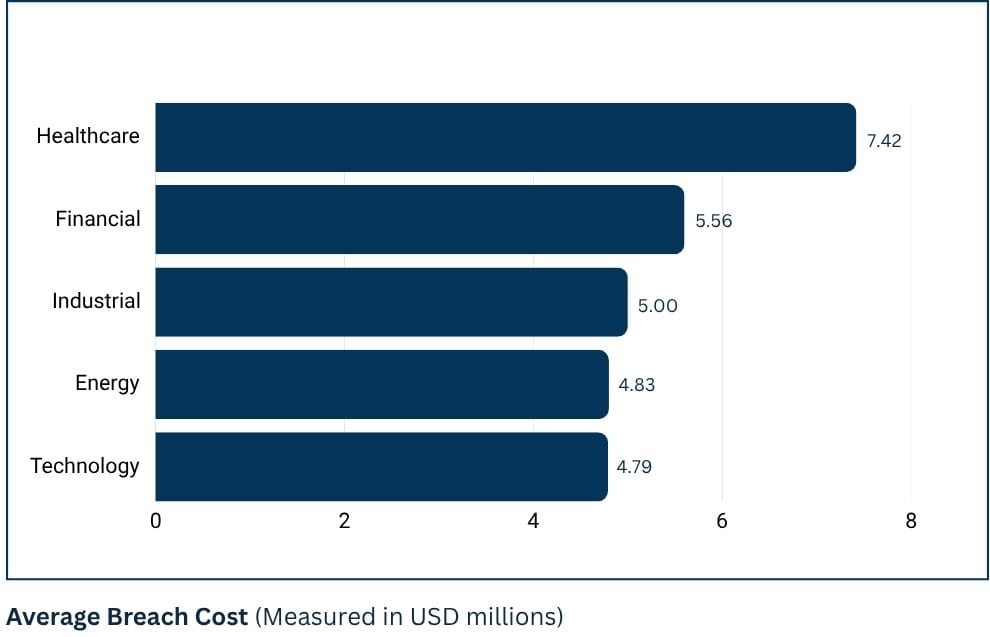
Source: IBM Cost of a Data Breach Report 2025
For a smaller organization in a regulated field, the risk is not only technical. It can affect operations, trust, compliance, and leadership confidence.
That is why Vancord’s work with financial services cybersecurity and healthcare data security focuses on practical protection that supports both security and business needs. Jim Betzig, CEO of Coastal Bridge Financial, a firm managing six billion dollars in assets, made the point directly: cybersecurity isn’t optional for an organization like his. It’s foundational to maintaining client trust and regulatory standing.
Preparation Matters More Than Size
The organizations that weather security incidents best aren’t always the largest. They’re the most prepared. They know what assets they have, they know who has access, and they have a clear plan for when something goes wrong.
Honestly, this is where most smaller organizations fall short. It’s not that they don’t care. It’s that no one has ever helped them build a structured approach to security that fits their budget and their team. For leaders who need structure but are not ready to hire a full-time security executive, Vancord’s Security Program Development through vISO can help build a practical security program. A vISO, or Virtual Information Security Office, gives organizations access to security leadership, planning, and guidance without relying on one internal person to carry everything alone.
Security isn’t a product you buy once. It’s an ongoing practice, and smaller businesses that treat it that way are the ones attackers move past when they’re looking for an easy win.
FAQ: Why Small Businesses Are Targeted by Cyber Attacks
Why do hackers target small businesses if they have less money than large corporations?
Small businesses often have weaker defenses and less monitoring than larger organizations, which makes a successful attack easier to execute. The data they hold, including customer records, payment details, and vendor credentials, still has real market value. For attackers, the lower barrier makes them an attractive and efficient target.
What is the most common cyber risk for small businesses?
Phishing emails remain the most common entry point. An employee receives a message that looks legitimate, clicks a link, and unknowingly surrenders credentials or installs malware. Security awareness training is one of the most direct ways to reduce that risk across your entire workforce.
How can I tell if my business is already exposed?
A security assessment can identify gaps in your systems, access controls, backups, and monitoring. Dark web monitoring can also help reveal whether employee credentials are already exposed online.
What’s the most useful first step for a small business trying to improve cybersecurity?
Start with a security assessment. You can’t protect what you don’t fully understand. A good assessment maps your current controls, identifies where your real exposure is, and helps you prioritize fixes in a way that makes practical sense for your budget and your team.
Build Security Before Attackers Force the Issue
Small businesses are targeted because attackers see value and opportunity. That does not mean every smaller organization needs a huge security department. It means every organization needs a clear plan, steady monitoring, and the right support.
Vancord’s Managed Security Services help organizations strengthen detection, response, monitoring, and security planning without overwhelming internal teams.
If you are not sure where your biggest risks are today, request a security assessment and get a clear, practical view of what to fix first.