























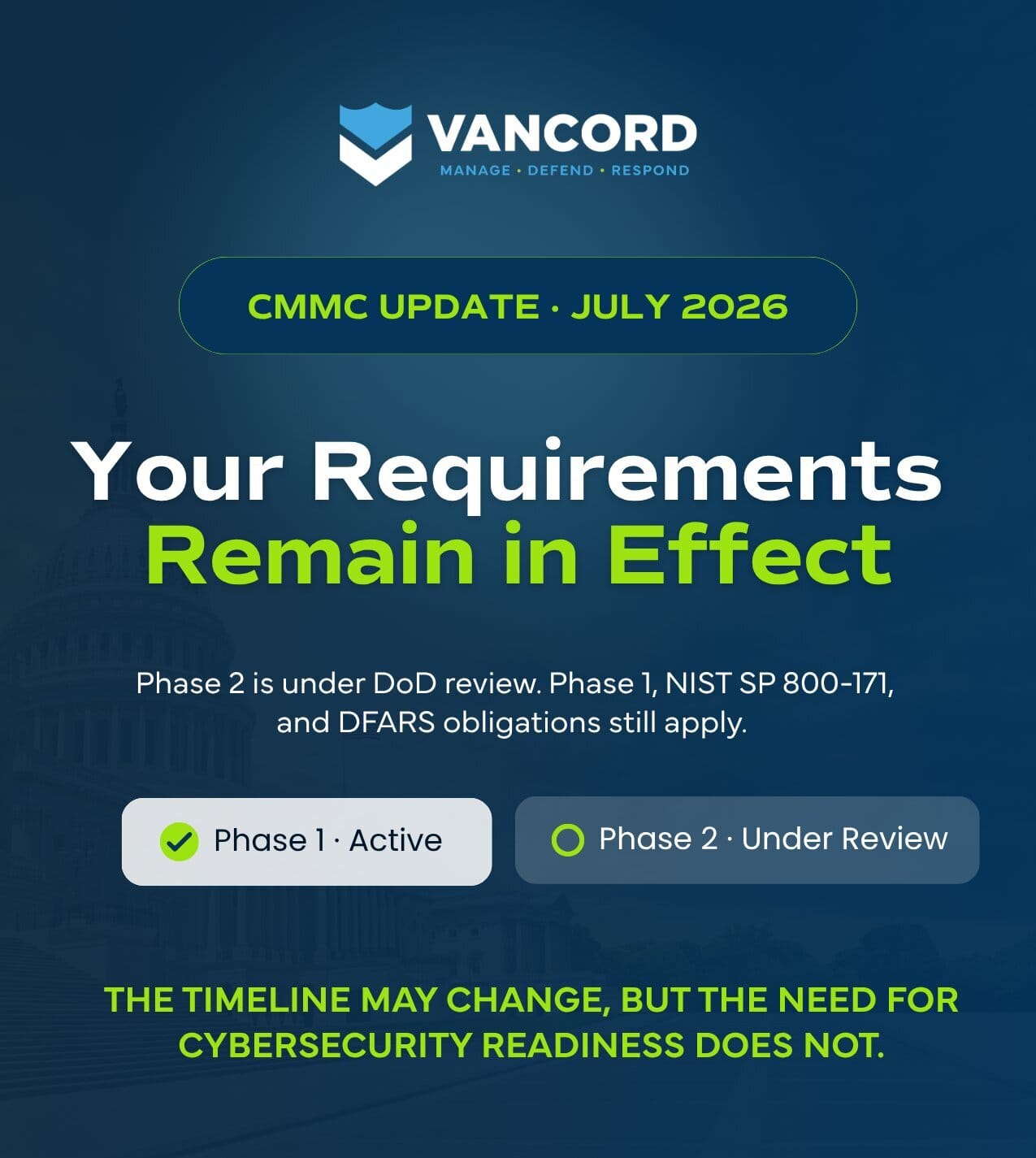
Important CMMC Update (July 2026)
The Department of Defense has suspended the planned rollout of CMMC Phase 2, including the planned expansion of mandatory Level 2 third-party (C3PAO) assessments, while it conducts a comprehensive review of the program.
What remains in effect:

CMMC Phase 1 implementation
Level 1 and applicable Level 2 self-assessments
NIST SP 800-171 cybersecurity requirements
DFARS 252.204-7012 obligations
Protection of Controlled Unclassified Information (CUI)

Organizations should continue strengthening their cybersecurity programs and maintaining compliance while awaiting further Department of Defense guidance.


The Risk of CMMC Non-Compliance
Vancord helps your organization assess its current security posture, remediate gaps, develop required documentation, and maintain readiness for evolving Department of War cybersecurity requirements.
- Loss of DoD contract eligibility
- Disqualification from future contract bids
- Supply chain removal by prime contractors
- Regulatory penalties for CUI mishandling
How Vancord Helps You Achieve CMMC Readiness
CMMC readiness requires more than a checklist. It takes technical controls, clear documentation, and a plan that aligns your business with Department of Defense requirements. Vancord helps Connecticut defense contractors move through the certification process with practical guidance, reduced disruption, and a clear path to compliance.

NIST 800-171 Gap Assessment

System Security Plan (SSP) Development

Remediation of Identified Gaps

Plan of Action & Milestones (POA&M)

Assessment Readiness (SPRS & C3PAO)

Ongoing Compliance Maintenance
What Our Clients Say

Berlin Steel
With Vancord, we finally have the dependable, knowledgeable IT partner we always needed. They know our environment, respond fast, and plan ahead so we’re never caught off guard. It’s the...
Read Full Testimonial
MercyFirst
Vancord completely changed how we manage IT. From replacing spreadsheets with a real support system to helping our staff become more tech-savvy, they’ve brought organization, reliability, and peace of mind....
Read Full Testimonial
Chelmsford Public Schools
Vancord’s team goes the extra mile. They tested our defenses, and ensured that our systems worked. Their proactive approach and quick collaboration gave us real confidence in our security posture....
Read Full Testimonial
Katey Cheplick
AVP for Technical Solutions & Systems
I’m Katey Cheplick. I am the associate vice president for technical solutions at Keuka College. I met Vancord through a series of events. Basically, we had a situation and an...
Read Full Testimonial
Jim Betzig
CEO - Coastal Bridge Financial
I’m Jim Betzig and I’m the CEO of Coastal Bridge Financial and we’re a registered SEC, a registered investment advisory firm that manages six billion dollars in assets. Cybersecurity is...
Read Full Testimonial
Andrew Johnson
Assistant to the CIO - ECSU
I’m Andrew Johnson. I work at Eastern Connecticut State University and it’s a public liberal arts university in Connecticut. Cyber security is important to us here at Eastern primarily because...
Read Full Testimonial
Lucy Healey
CFO - A Secondino and Sons
The relationship between A. Secondino and Son, Inc. (“ASSI”) and Vancord has come to feel like more of a partnership than a customer/provider experience. Not only do we consult on...
Read Full Testimonial
Phil Ames
CISO - Raiinmaker
In preparation for a product launch at Raiinmaker, we evaluated several providers and decided to engage with Vancord. Vancord’s team was great at working with us and our aggressive timelines...
Read Full Testimonial
Ryan Pasquella
Vice President - JRC Corporate
Our partnership with Vancord enables us to stay focused on what we do best, while trusting that our technology needs are in expert hands. Their team brings deep knowledge across...
Read Full Testimonial
OMEGA Engineering
Vancord has been very professional and dedicated to us on any request, no matter what. We like the support that Vancord gives us. All of the Vancord support engineers are...
Read Full Testimonial
Saint Thomas More Chapel & Center at Yale University
STM would like to commend Vancord and its entire staff for its outstanding performance and dedication to excellence. With the difficulty of staying ahead of the technological trends, Vancord has...
Read Full Testimonial
Albertus Magnus College
Vancord has been a close partner with Albertus for many years, and our increasingly close relationship results from the clear development and expansion of the services and expertise of the...
Read Full Testimonial
Family Vision Center
We have had the pleasure of working with Vancord to get our new office IT needs satisfied. We have received exceptional customer service all throughout this project… everyone has gone...
Read Full Testimonial
Chapel Haven Schleifer Center, Inc.
Chapel Haven has had the pleasure to work with Vancord for both service and support, as well as at a major project level. All employees at Vancord have been tremendous...
Read Full Testimonial
Generations OBGYN
I, personally, have been working with Vancord since 2010. Together, we have experienced some out-of-the-norm occurrences (fire, floods, office relocations). As a Practice Manager, I have come to know what...
Read Full Testimonial
Merchant Financial Group
… I had several high-priority projects either in process, one being our company-wide cut-over from a workgroup network to Active Directory. Vancord’s work on setting up our new AD system...
Read Full Testimonial
Milford Fire Department & Police Department
I must say that Vancord…has been nothing but exceptional in helping me on the public safety networks for both Police and Fire… demonstrating professionalism and has a great deal of...
Read Full TestimonialConnecticut Industries That Need CMMC




Why Clients Trust Vancord
See what business leaders, IT teams, schools, municipalities, and organizations are saying about their experience working with Vancord.














Ready to Start Your CMMC Compliance Journey?
Whether you are beginning your NIST SP 800-171 compliance journey, completing required self-assessments, or preparing for future CMMC assessment requirements, Vancord can help you understand your obligations, close security gaps, and move forward with confidence.
"*" indicates required fields
Frequently Asked Questions About CMMC Compliance
- CMMC 2.0 is the updated cybersecurity framework for Department of Defense contractors. It simplified the original model by reducing five maturity levels to three levels and aligning requirements more closely with existing standards such as NIST SP 800-171. It also introduced limited self-assessments for some contractors while keeping third-party assessments for higher-risk environments.
- Yes. On July 13, 2026, the DoD suspended CMMC Phase 2, the planned rollout of mandatory third-party (C3PAO) assessments and launched a 60-day review of the program. Phase 1 remains fully in effect: applicable contracts still require Level 1 and Level 2 self-assessments submitted to the Supplier Performance Risk System (SPRS). The 110 NIST SP 800-171 controls and DFARS 252.204-7012 safeguarding obligations also remain mandatory. The suspension changes how compliance is verified, not whether you must comply.
- If your company works with the Department of Defense, supports a defense contractor, or handles Controlled Unclassified Information (CUI), you may need CMMC certification. This often applies to Connecticut manufacturers, engineering firms, IT providers, and suppliers in defense-related supply chains.
- Level 1 focuses on protecting Federal Contract Information (FCI) through basic cybersecurity practices and annual self-assessments. Level 2 is designed for organizations that handle Controlled Unclassified Information (CUI) and is based on the 110 security requirements in NIST SP 800-171. As of July 2026, the Department of War has suspended the planned rollout of mandatory Level 2 third-party assessments, but applicable contracts may still require Level 2 self-assessments during Phase 1 implementation.
- CUI is sensitive government-related information that is not classified but still requires protection. Examples may include technical drawings, engineering data, contract information, operational procedures, or other regulated data shared with contractors.
- The timeline depends on your current security posture, documentation readiness, and the number of gaps to remediate. Some organizations may be ready in a few months, while others need longer. As of July 2026, mandatory third-party certification assessments are suspended, but Level 2 self-assessments are still required for applicable contracts, so a CMMC assessment and Plan of Actions and Milestones (POAM)remain the right starting point regardless of how the DoD's review concludes.
- NIST SP 800-171 is a cybersecurity standard that defines how organizations should protect Controlled Unclassified Information in non-federal systems. CMMC Level 2 is built around these same controls, making NIST SP 800-171 the foundation for many CMMC certification requirements.