



An incident response plan can look complete and still fail when a real cyberattack happens. The reason is simple. A plan that has never been tested is still a guess. Teams may not know who makes decisions, who calls legal, which systems matter most, or how to keep the business running while the threat is being contained. Incident response plan testing helps your organization find those gaps before an attacker does.
An Incident Response Plan Is Not Enough If No One Has Practiced It
Many organizations have a cyber incident response plan. It may live in a shared folder, a policy binder, or a compliance file. On paper, it may include the right steps: detect the issue, contain the threat, remove the attacker, restore systems, and review what happened.
That is a good start. But a written plan does not prove your team is ready.
A real cyber incident is messy. Alerts come in fast. People are stressed. Leaders want updates. Employees may be locked out. Systems may be offline. Customers, students, patients, or partners may be waiting for answers.
A strong plan should help people act quickly. A weak or untested plan creates more questions when the team needs clear direction.
That is when an untested plan starts to show its cracks.
Vancord’s Tabletop Exercises & Incident Response Testing service is built for this exact problem. It helps teams practice real-world cyber scenarios, test decision-making, and improve response plans before a real incident creates pressure.
Why Cyber Incident Response Plans Fail in Real Life
Most incident response plans do not fail because people do not care. They fail because the plan has not been used in a realistic setting.
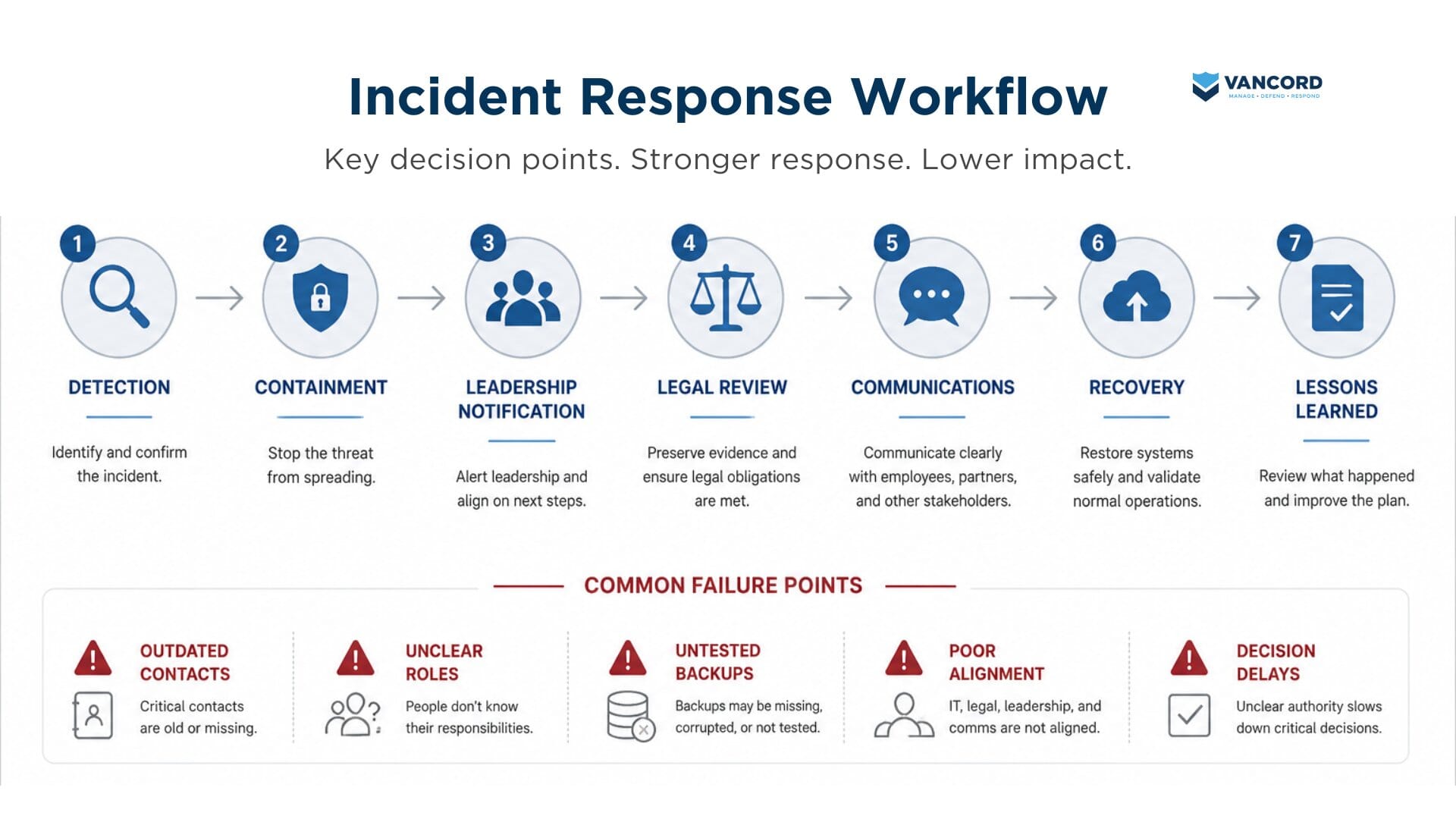
Most incident response plans do not fail because people do not care. They fail because the plan has not been used in a realistic setting.
A plan may say, “Notify leadership,” but not explain who gets the first call. It may say, “Restore from backup,” but no one has tested whether the backup is clean. It may say, “Contact insurance,” but no one knows what details the carrier needs before support begins.
Small details become big delays during a cyberattack.
The most common failure points are usually practical:
- The contact list is old.
- Roles are unclear.
- Legal, IT, leadership, and communications are not aligned.
- Backup recovery steps have not been practiced.
- No one knows who can approve major decisions.
- The plan does not match current systems, vendors, or staff.
These are not small issues. During ransomware, account takeover, or a suspected data breach, every delay gives the threat more time to spread.
IBM’s 2025 Cost of a Data Breach Report lists the global average cost of a breach at $4.4 million and connects the year-over-year decrease to faster identification and containment. That matters because tested response plans are one way organizations improve speed, coordination, and containment.
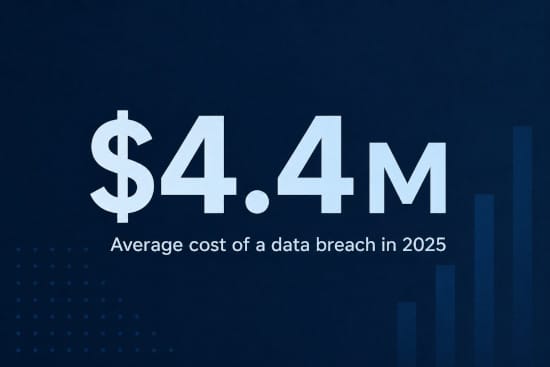
Source: IBM’s 2025 Cost of a Data Breach Report
Incident Response Testing Finds the Gaps Before the Attack
Incident response plan testing is the practice of walking through a cyber incident before it happens. The goal is not to embarrass the team. The goal is to find weak spots while there is still time to fix them.
A common way to do this is through a cybersecurity tabletop exercise.
In a tabletop exercise, your team works through a realistic scenario such as ransomware, phishing, vendor compromise, stolen credentials, or suspicious activity inside the network. No real systems are taken offline. Instead, the team talks through what they would do, who would be involved, what decisions need to be made, and where the plan is unclear.
CISA’s Tabletop Exercise Packages are designed to help organizations discuss pre-incident planning, incident response, information sharing, and recovery. NIST also notes that incident response exercises and tests can help evaluate the program and prepare staff and third parties for future response activities.
In simple terms, testing turns a document into a working process.
Tabletop Exercises Help Leadership Make Faster Decisions
Cyber incidents are not only technical events. They are business events.
When a serious alert comes in, IT may need to isolate systems. Legal may need to protect evidence. Leadership may need to decide whether operations should pause. Communications may need to prepare clear language for employees or customers. Finance may need to understand downtime risk. HR may need to help with employee messaging.
If those groups meet for the first time during the incident, the response will be slower.
A tabletop exercise gives those teams a safe place to practice together. It helps answer questions like:
- Who leads the response?
- Who talks to employees?
- Who contacts outside partners?
- Who approves system shutdowns?
- Who decides when it is safe to restore operations?
- Who documents the timeline?
That level of clarity is where many organizations gain the most value.
Vancord’s broader Cybersecurity Strategy & Compliance services include incident readiness, tabletop exercises, cyber readiness assessments, security awareness training, and privacy and compliance support. That makes testing part of a larger security program, not a one-time meeting.
Real Incidents Show Why Practice Matters
The value of readiness becomes clear when something happens outside normal business hours.
In one Vancord manufacturer case study, a U.S. company faced unusual VPN activity over a weekend. Vancord’s Security Operations Center detected the activity, contained the intrusion, and helped strengthen identity and access controls. According to the case study, the company avoided data loss and downtime.
That outcome did not come from a document sitting in a folder. It came from monitoring, fast action, clear response steps, and experienced people knowing what to do.
Another Vancord public sector case study shows how incident response often requires a custom approach. Vancord deployed engineers to investigate the issue, contain the attacker, remove malware and attacker tools, and restore systems for normal operations.
These examples show an important point. A response plan must work in the real world, not just in a policy file.
What a Strong Incident Response Test Should Cover
A useful test should match the risks your organization actually faces.
For a school, that may mean a student data incident, ransomware, or a compromised staff account. For a manufacturer, it may mean a production disruption, VPN abuse, or suspicious activity tied to a supplier. For a public sector organization, it may mean a public safety system outage or sensitive data exposure.
The exercise should include more than IT. The right group usually includes IT, security, leadership, legal, communications, operations, and any outside partner that would play a role during a real incident.
A strong test should answer four basic questions.
First, can the team detect and confirm the problem quickly?
Second, does everyone know their role?
Third, can the organization communicate clearly without creating confusion?
Fourth, can the business recover safely without rushing systems back online too soon?
After the exercise, the team should document what worked, what failed, and what needs to change. That after-action review is where the real improvement happens.
Incident Response Plan Testing Also Supports Compliance and Insurance
Many organizations think about incident response testing because of compliance or cyber insurance. That is valid.
A tested plan can support audit readiness, board reporting, customer requirements, insurance reviews, and internal risk management. It also shows that the organization is not just writing policies. It is practicing them.
This is especially important for industries Vancord supports, including education, manufacturing, public sector, healthcare, finance, and nonprofits. These groups often face a mix of limited resources, sensitive data, operational pressure, and strict expectations.
For mid-market organizations, testing can be one of the most practical ways to improve security without turning everything into a large technical project.
How Often Should You Test an Incident Response Plan?
Most organizations should test their incident response plan at least once a year. Some should do it more often, especially if they handle sensitive data, have compliance requirements, rely on critical systems, or have recently changed tools, vendors, leadership, or business processes.
You should also test after a major system change, a cyber insurance renewal, a merger, a new compliance requirement, or a real security event.
The goal is not to make the plan perfect. The goal is to keep it useful.
A plan that changes with the business is far more valuable than a polished document that no one trusts during a crisis.
FAQ: Incident Response Plan Testing
What is incident response plan testing?
Incident response plan testing is the process of practicing your cyber incident response plan before a real attack happens. It helps your team confirm roles, communication steps, decision-making, containment actions, and recovery needs.
What is a cybersecurity tabletop exercise?
A cybersecurity tabletop exercise is a guided practice session based on a realistic cyber incident. The team talks through what they would do, who would be involved, and where the current plan needs improvement.
Why do incident response plans fail?
Incident response plans often fail because they are outdated, unclear, untested, or disconnected from how the organization works today. The biggest problem is usually not the plan itself. It is the lack of practice.
Who should be part of an incident response test?
IT, security, leadership, legal, compliance, communications, operations, and key business leaders should be included. The exact group depends on the scenario and the organization.
Does incident response testing replace incident response services?
No. Testing helps prepare your team before an incident. Incident Response Services help contain, investigate, and recover from an active cybersecurity event. Both are important parts of a stronger security program.
Test the Plan Before the Incident Tests You
An incident response plan should not sit untouched until something goes wrong. It should be practiced, questioned, updated, and tested against the kinds of threats your organization is most likely to face.
Vancord helps organizations run practical tabletop exercises, strengthen incident readiness, and prepare teams to respond with less confusion and more control.
If your response plan has not been tested recently, contact Vancord to start a readiness conversation before the next alert becomes a crisis.