



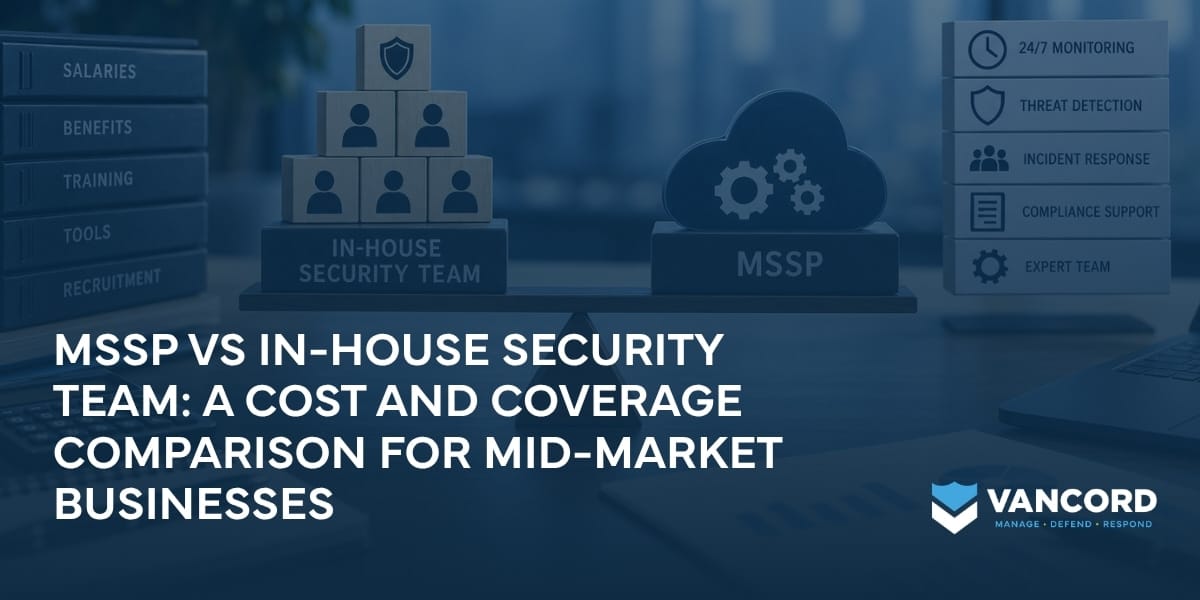
At some point, almost every mid-market business faces the same decision. The IT generalist handling security alongside everything else is stretched past their limit. A near-miss happens, or a customer requests documentation your team cannot produce, or the cyber insurance renewal arrives with requirements nobody was ready for. Leadership starts asking the question that has been sitting in the room for months: do we hire our own security people, or bring in a Managed Security Service Provider? Both options sound reasonable on paper until you look at actual dollar figures, actual coverage gaps, and what each one delivers for a company with 50 to 500 employees. This guide puts real numbers behind the comparison, addresses the talent and coverage realities that rarely make it into sales conversations, and gives mid-market decision-makers a framework that is based on facts rather than vendor preference.
Quick Answer: For many organizations with 50 to 500 employees, partnering with an MSSP is often more cost-effective than building and maintaining a fully staffed internal security team. An MSSP provides access to 24/7 monitoring, experienced security analysts, and specialized expertise through a predictable monthly investment. The right choice depends on your security goals, compliance requirements, existing IT resources, and budget.
Why Mid-Market Businesses Are Rethinking Their Security Model
The version of cybersecurity that existed ten years ago, where a capable IT person handled security as part of a broader role, stopped working a while back. The threat environment changed, the attack surfaces expanded, and the regulatory expectations for businesses handling sensitive data grew more demanding in almost every sector.
Mid-market organizations, those roughly between 50 and 500 employees, face a specific version of this problem. They are large enough to be attractive targets and to face compliance frameworks like CMMC, HIPAA, PCI DSS, and NIST, but often not large enough to justify the cost of building a fully equipped internal security function. Ransomware groups understand this gap and target it deliberately, often timing attacks for nights and weekends precisely because those are the hours when mid-market environments run with the lightest coverage.
The question is no longer whether to invest in security. It is how to structure that investment so it actually delivers the protection the business needs.
What Does Building an In-House Security Team Actually Cost?
This is where the conversation almost always goes wrong. Decision-makers look at one analyst’s salary and do quick math that does not account for what full security coverage actually requires.
A security analyst in the United States earns between $95,000 and $130,000 annually, depending on experience and location. Add benefits, which typically run 30 to 35 percent of base salary, and a single person costs between $125,000 and $175,000 fully loaded before anything else enters the picture.
The problem is that one analyst cannot provide 24/7 coverage. Real 24/7 monitoring, the kind that actually investigates alerts rather than just acknowledging them, requires four to six analysts minimum across rotating shifts, plus a security engineer, a team manager, and a technology stack to support all of them. At that staffing level, personnel alone runs between $800,000 and $1.5 million annually.
Then comes the technology. A SIEM platform, endpoint detection and response tools, threat intelligence feeds, and vulnerability scanning software together run between $150,000 and $500,000 per year for a mid-market deployment. Recruitment fees when people leave, which they do with regularity in this field, typically run 20 to 30 percent of first-year salary per hire. Certifications expire and cost $3,000 to $10,000 per analyst to renew each year.
The IBM Cost of a Data Breach Report documents that slower detection and containment times produce significantly higher breach costs. Coverage gaps during off-hours are not a theoretical risk. They are a measurable financial liability.
What Does an MSSP Cost for a Mid-Market Business?
For mid-market organizations, a comprehensive managed security engagement typically runs between $3,000 and $15,000 per month, depending on scope, company size, and service tier.
At the lower end of that range, you get log monitoring, alert triage, and device management. At the higher end, you get active threat hunting, behavioral analysis, incident response support, compliance documentation, and direct analyst engagement when something requires human investigation. For most mid-market businesses looking for genuine protection rather than minimum viable coverage, the realistic range sits between $5,000 and $12,000 per month.
Even at $10,000 per month, the annual cost is $120,000. That is roughly 10 to 15 percent of what it costs to build comparable coverage internally. The cost difference exists because MSSPs distribute their technology and staffing costs across an entire client base. The same SIEM platform, threat intelligence feeds, and analyst expertise that would take millions to build from scratch get shared across dozens or hundreds of client environments.
Vancord’s managed security services operate on this model, giving mid-market organizations access to a full security team, 24/7 Security Operations Center monitoring, and incident response capacity without the overhead of building any of it internally.
Beyond Cost: What Each Approach Actually Covers
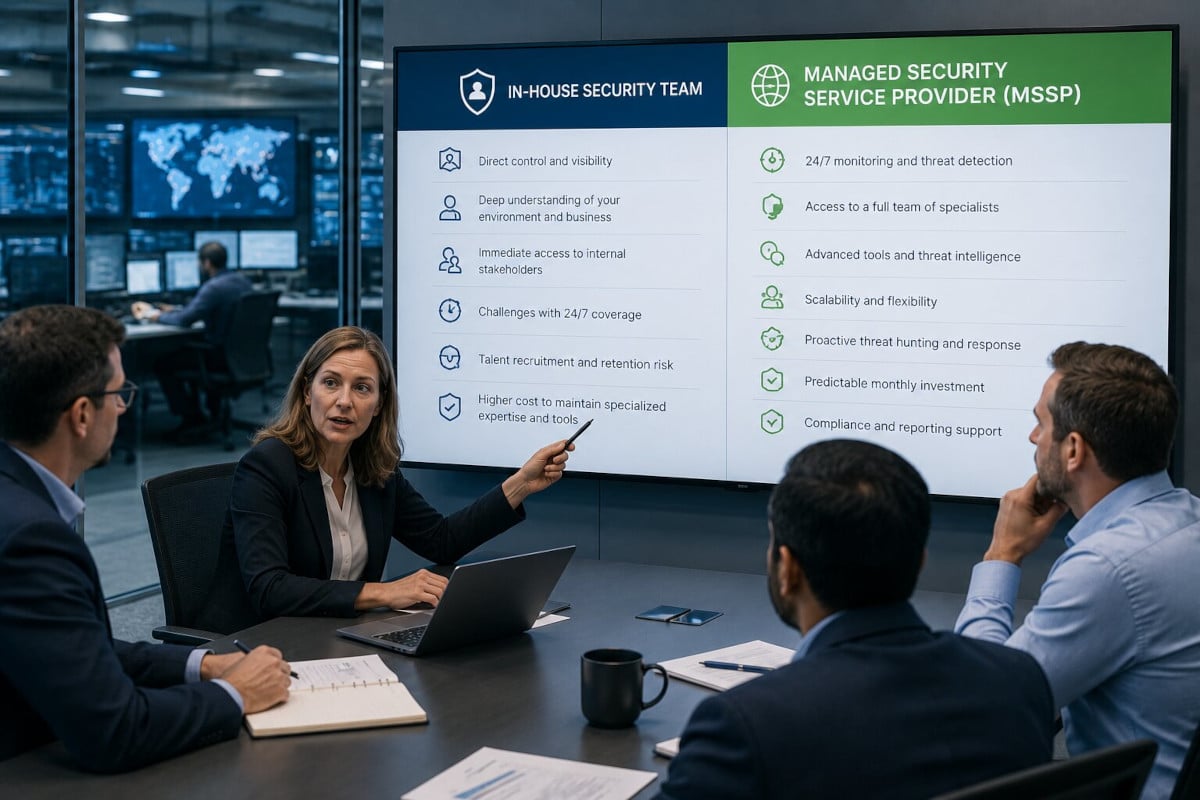
Cost is one dimension. What each option actually delivers when an incident happens is the more important question.
An in-house team gives your organization direct control over how security decisions get made. Your analysts develop deep familiarity with your specific environment, can escalate directly to internal leadership, and bring business context that no outside provider immediately has. For large enterprises with highly specific compliance requirements, or organizations where external access to systems carries unacceptable regulatory risk, that proximity has genuine value.
The limitations become visible at the edges of the workday and at the edges of expertise. When your most experienced analyst accepts a better offer elsewhere, the gap during recruitment is real exposure. When a critical alert fires at 3 a.m. on a holiday weekend, whatever is actually watching at that moment is what your organization has. When a novel attack technique appears that your team has not encountered before, the learning curve costs time you may not have.
An MSSP fills those edges differently. Threat intelligence shared across many client environments gives providers exposure to attack patterns that no single-organization team can replicate. Specialized capabilities including digital forensics, malware analysis, continuous vulnerability management, and compliance reporting for frameworks like CMMC, HIPAA, and NIST are available without requiring your organization to hire dedicated specialists for each discipline.
The honest trade-off is process ownership. Security operations happen within the provider’s escalation structure, and the relationship delivers its best value when the provider genuinely understands your environment and industry. A partner who knows your business delivers fundamentally different outcomes than one processing your alerts in a generic queue.
The Talent Shortage Making In-House Security Harder to Sustain
The hiring market compounds every challenge in the in-house model. The 2025 ISC2 Cybersecurity Workforce Study found that 88% of organizations experienced a significant security consequence in the past year tied directly to a skills deficiency in their teams. The World Economic Forum’s Global Cybersecurity Outlook 2025 found that only 14% of organizations currently have the security skills they need.
For mid-market companies competing against larger enterprises and technology firms for candidates who have multiple offers and specific salary requirements, the odds of consistently hiring and retaining qualified security talent are not favorable. Positions stay open for months. Experienced analysts leave for better compensation. Entry-level hires require time and investment before they can operate independently.
An MSSP absorbs all of that on the provider’s side. When an analyst leaves, the provider handles backfill. When new attack techniques emerge, the provider trains across the team. When certifications expire, the provider manages renewal. Your organization receives the output of that team without carrying the cost or uncertainty of maintaining it.
This dynamic also explains why MSSP and internal IT work better together than as competing models. How that relationship functions in practice, and why it serves mid-market businesses better than either option alone, is something Vancord covered directly in our post on how MSSPs work alongside internal IT teams.
Compliance, Response Speed, and the Hybrid Option
For mid-market businesses in regulated industries, compliance is not a background concern. CMMC for defense contractors, HIPAA in healthcare, PCI DSS for payment processing, and FERPA in education all carry real consequences when security controls fall short during an audit or an incident.
A well-structured MSSP addresses compliance as part of ongoing operations rather than a scramble before each audit. Continuous monitoring, incident documentation, log management, and security reporting provide many of the operational controls auditors expect to see. Vancord’s compliance and incident readiness services are built around exactly this approach.
The strongest security programs for mid-market organizations often combine internal IT with an external security layer rather than choosing exclusively between the two. Internal staff handles daily technology operations, user support, and infrastructure management. The MSSP provides 24/7 threat monitoring, incident response, vulnerability management, and compliance support. Each team contributes what it is best positioned to deliver.
If your organization is still assessing where it stands, a cybersecurity readiness and risk assessment is the most practical starting point. And if the warning signs have already appeared, our post on the top signals it may be time to partner with an MSSP walks through each one in detail.
Frequently Asked Questions About MSSP vs In-House Security
How much does an in-house security team cost for a mid-market company?
A fully staffed team capable of 24/7 monitoring typically costs between $800,000 and $1.5 million annually, covering salaries, benefits, technology, training, and recruitment. A single analyst runs $95,000 to $130,000 in base salary before overhead. Security tooling adds another $150,000 to $500,000 per year.
What does an MSSP cost for a mid-market business?
Comprehensive managed security services for mid-market organizations typically range from $3,000 to $15,000 per month. That is $36,000 to $180,000 annually for coverage that would cost significantly more to build internally.
Can an MSSP replace our internal IT team?
No. An MSSP handles security-specific monitoring, threat detection, and incident response. Your internal IT team continues managing the technology the business runs on. The two are complementary, and most mid-market organizations benefit most from running both together.
What size business benefits most from an MSSP?
Organizations with approximately 50 to 500 employees see the strongest value because they face real cybersecurity risk and compliance requirements but often cannot justify the full cost of building an internal 24/7 security operations center. An MSSP gives these businesses enterprise-level coverage without enterprise-level build costs.
What industries benefit most from managed security services?
Manufacturing, healthcare, education, financial services, and defense contractors see the strongest value because they manage sensitive or regulated data, face compliance frameworks with documented control requirements, and cannot afford significant downtime if an incident disrupts operations.
Can an MSSP help our business with compliance?
Yes. MSSPs regularly support organizations working toward CMMC, NIST 800-171, HIPAA, PCI DSS, and NIST CSF by providing continuous monitoring, security reporting, incident documentation, and risk assessments. These services supply many of the operational controls auditors look for without requiring your team to manage each one independently.
Ready to Find the Right Security Model for Your Business?
For most mid-market businesses, the numbers favor an MSSP. The cost gap is significant, the talent market makes consistent in-house hiring difficult, and coverage gaps from limited headcount represent compounding risk every day they persist.
What matters most beyond the cost comparison is choosing a provider that understands your industry, your compliance environment, and how your business actually operates. Berlin Steel found exactly that when they started working with Vancord. As they described in their own words on the Vancord site, they finally had a knowledgeable partner who understood their environment and planned ahead rather than reacting after problems surfaced.
Contact Vancord to speak with a security specialist who works with mid-market businesses every day, or request a security assessment to get a clear, honest picture of where your organization currently stands.