



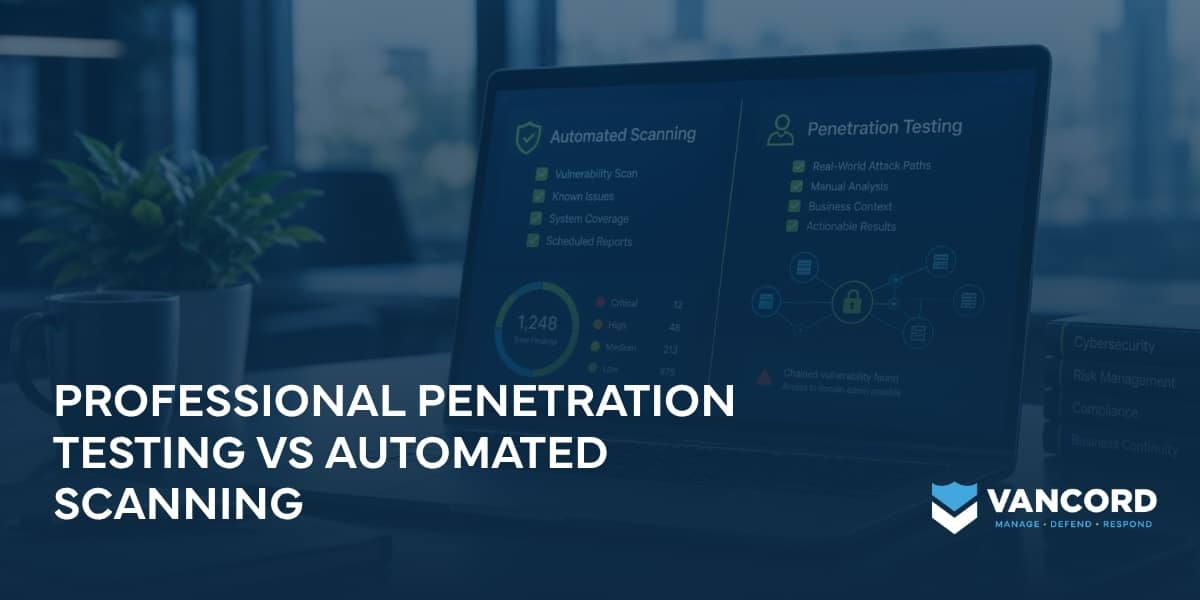
A vulnerability scanner can check thousands of systems in a morning and repeat the job every month. What it can’t do is recognize that a medium-severity finding, an overshared file server, and a service account with a ten-year-old password together add up to domain admin. That gap is the practical difference between automated scanning and professional penetration testing. Most organizations need both, and each one answers a different question.
Penetration Testing vs Automated Scanning: The Short Answer
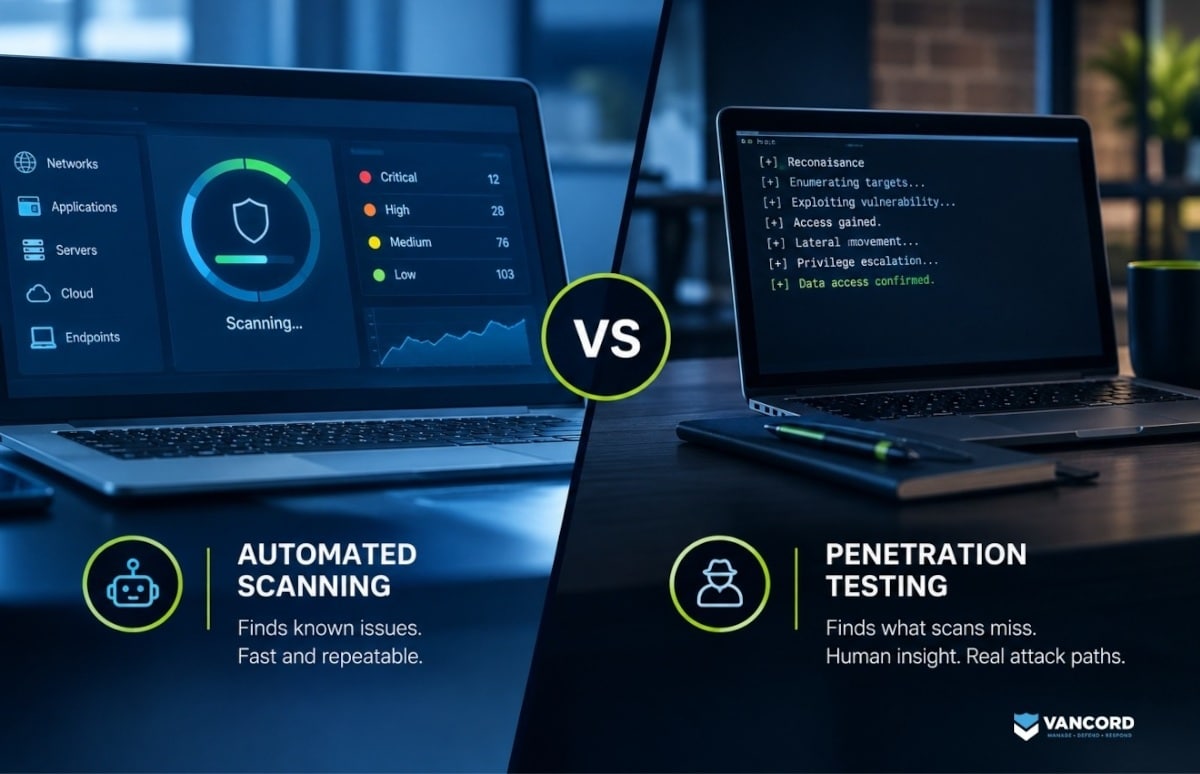
Automated vulnerability scanning uses software to check systems against a large library of known problems: missing patches, outdated versions, exposed services, weak default settings, and published vulnerabilities (CVEs). It’s fast and repeatable, and it can cover every asset in an environment.
A professional penetration test starts from a different place. Rather than checking systems against a list, a tester works your environment the way an attacker would: mapping what’s exposed, finding a foothold, and exploiting it within an agreed scope using purpose-built and custom tooling. Each step informs the next, with the goal of determining how far an attacker could get.
A scan tells you where known weaknesses probably are, and a pen test shows you what an attacker could actually do in your environment and what they would reach.
The two work alongside each other rather than competing. For a comparison of vulnerability assessments and penetration tests as services, see our guide to penetration testing vs vulnerability assessments. This post takes on a narrower question: what automated tools can find on their own, and where human-led testing picks up.
What Is Automated Vulnerability Scanning?
Vulnerability scanners are built for breadth. Given a network range or a list of cloud assets, a scanner identifies the services and software it can see, compares their versions against databases of known vulnerabilities, and checks configurations against a set of rules. Because scans run on a schedule, a system that falls behind on patches shows up at the next scheduled scan rather than at the next annual review.
Frequency matters because environments change constantly. Laptops are replaced, new cloud services are turned on, vendors are given remote access, and new vulnerabilities are published every day. An annual test captures a single point in time, and scanning provides visibility between those points. Scanning is the foundation of our Continuous Vulnerability Management service, where regular scans feed a prioritized remediation process.
Recent breach data supports this. In the 2026 Verizon Data Breach Investigations Report, exploitation of vulnerabilities was the most common initial access vector, at 31% of breaches, up from 20% the year before. It’s the first time in the report’s history that exploitation has overtaken stolen credentials. The same report found organizations had fully remediated only 26% of the vulnerabilities on CISA’s Known Exploited Vulnerabilities list, and the median time to fully patch one grew to 43 days.
The remediation numbers are the more telling ones. Finding a vulnerability and fixing it are separate jobs, and many programs fall behind on the second. A scanner is only as useful as the process that acts on its results.
It’s also worth confirming whether your scans are credentialed. An unauthenticated scan sees systems roughly the way an outsider on the network would. A credentialed scan logs in and can inspect installed software and local configuration, so it finds considerably more.
What Automated Scanners Miss
Scanners work by matching what they observe against known issues. They have no understanding of what the business does, which data matters most, or how systems trust one another.
NIST SP 800-115, the federal guide to technical security testing, addresses this directly. Although it was published in 2008, its description of scanner limitations remains accurate. It describes scanners as finding mostly surface vulnerabilities, meaning weaknesses that exist in isolation, and warns that they can have a high false positive rate. More importantly, it notes that several low-risk vulnerabilities can present a higher risk when combined, and that scanners can’t detect problems that only appear through combinations of attack steps. NIST recommends that someone with relevant expertise interpret scan results, and it identifies penetration testing as the more reliable way to understand vulnerabilities in aggregate.
A common internal example illustrates the point. A scan reports that SMB signing isn’t required on a group of servers. The finding is usually rated medium and is often left unaddressed. Separately, workstations are still answering legacy name resolution requests (LLMNR and NBT-NS), which many network scanners don’t report at all. Neither finding looks urgent on its own. Combined, they allow someone on the internal network to trick machines into sending authentication attempts their way and relay them to servers that don’t require signing. If a captured account has administrative rights on one of those servers, the attacker gains the same access. Two issues that look minor on their own become a serious attack path.
Other gaps are more ordinary: a customer portal where changing one number in the URL displays another customer’s invoice, a file share open to every employee that contains payroll exports, or a service account whose password has never changed and whose permissions nobody remembers granting. None of these match a signature in a vulnerability database, but they’re often apparent to a tester approaching the environment with an attacker’s objectives.
Real Example: What a Pen Test Found That a Scan Missed
A regional K-12 public school district in Massachusetts had recently brought on Vancord’s Managed Detection and Response service and wanted proof that its new security investments were working. The district was running a legacy on-premises Microsoft Exchange environment and had concerns about weak password habits. We performed internal and external penetration testing while our 24/7 SOC monitored the activity.
On the external side, our testers focused on the Exchange login portal and ran a controlled password spray, trying a small number of common passwords across many accounts. They identified several weak credentials, including one tied to an administrative account with broad access.
A scanner pointed at that portal would most likely have reported that the Exchange server was outdated, which is useful information. It wouldn’t have shown that someone on the internet could sign in as an administrator with a guessed password. The software was only part of the problem. The larger issue was a common authentication weakness on an account with significant access, and identifying it required a tester to connect the two.
The engagement also tested the district’s ability to detect an attack. The SOC identified the unusual login activity while the test was underway, so the district could see both what an attacker could attempt and whether its monitoring would catch it. Comparing the two exposed a gap: the SOC caught the identity-based activity, but some quieter network reconnaissance went unnoticed, which showed the district where additional logging would help.
Afterward, the district reset the affected accounts, strengthened its password policy, and enforced MFA for remote access. Testing was scheduled around the district’s calendar and caused zero downtime. The full school district case study goes into how our analysts spotted the activity as it happened.
Can Automated Penetration Testing or AI Penetration Testing Replace a Human Tester?
Vendors increasingly market “automated penetration testing” and “AI pen testing.” These tools go a step beyond scanning by attempting common attack techniques, chaining some of them together, and repeating the process on a schedule. They are useful for catching recurring, straightforward mistakes.
Attackers are using AI as well. The 2026 DBIR examined how threat actors used generative AI and found that the median actor sought AI help with about 15 documented attack techniques, with some reaching 40 or 50. Less discussed is that fewer than 2.5% of the AI-assisted malware observations involved less common techniques. For now, AI is mostly helping attackers carry out well-known techniques faster. Dylan Marquis, who leads our penetration testing practice, and I discussed what that means on a CyberSound episode about AI and vulnerability discovery. Our takeaway was that AI makes everyone faster, testers included.
What these tools can’t do on their own is understand the business, decide what’s safe to try, or recognize when to stop. NIST’s guide cautions that some scans can cause system failures on older systems, particularly those with weak security. On a factory floor, a fragile controller failing can stop a production line. Making those judgments is a large part of securing plant systems without disrupting production.
Manual Penetration Testing vs Automated Scanning
The simplest way to compare the two is by the question each one answers.
| Automated vulnerability scanning | Professional penetration testing | |
|---|---|---|
| Question it answers | Where are the known weaknesses? | What could an attacker actually do with them? |
| How it works | Software checks systems against known signatures and rules | A tester works the environment like an attacker, with purpose-built and custom tooling, and adapts to what they find |
| Speed | Fast and cheap to repeat | Slower, scoped engagement |
| Human judgment | Needed to review and triage results | Drives the whole engagement |
| Chained attack paths | Generally not detected | The main thing the tester is looking for |
| False positives | Common, so results need triage | Findings are validated before they’re reported |
| Typical cadence | Monthly or more often | At least annually, and after major changes |
| Best use | Ongoing visibility and hygiene | Validating real-world risk |
The two are complementary. Scanning without testing produces a long list with little sense of what matters most. Testing without scanning provides a detailed view once a year and limited visibility the rest of the time.
How Often Should You Scan and Perform a Penetration Test?
The CIS Controls are a reasonable benchmark. For organizations following the applicable safeguards, CIS recommends automated vulnerability scans of externally exposed assets at least monthly and of internal assets at least quarterly. For penetration testing, it calls for external and internal tests no less than annually.
These are minimums. In environments that change quickly, more frequent scanning adds little cost and shortens the time a new weakness goes unnoticed. Regulatory or contractual obligations may also set their own testing requirements, so check your specific framework rather than relying on CIS alone.
Penetration testing should also follow change, not just the calendar. Good reasons to test outside the annual cycle include launching a major application, moving important systems to the cloud, changing how remote access works, completing a merger or acquisition, or making significant network changes. A retest after remediation is also worthwhile to confirm the attack path has been closed.
In every case, the question to plan around is the same: if someone targeted this environment today, what could they actually reach?
How to Tell If a Pen Test Is Really Just a Scan
Some services sold as penetration tests are largely automated scans with a formatted report, and the difference isn’t always clear from a proposal. A few questions help separate the two.
- Who is doing the testing? You should be able to get names and hands-on credentials. Every Vancord test is run by OSCP-certified professionals. To earn the OSCP, a tester has to compromise a set of lab machines during a proctored exam that runs just under 24 hours, then document the attacks in a professional report.
- How much of the work is manual? If the answer boils down to “we run the tools and send you the results,” you’re buying a scan.
- Can you see a sample report? A thorough report walks through how the tester gained access, step by step, in enough detail for your team to reproduce it. A list of CVSS scores isn’t a penetration test report.
- What happens if they find something critical mid-test? An experienced team notifies you the same day rather than waiting for the final report.
- How do they keep testing safe? Experienced testers ask about fragile systems, account lockout thresholds, maintenance windows, and off-limits assets before they start.
See how Vancord’s penetration testing services work, from scoping through the final report.
Are Penetration Tests Safe to Run on a Live Network?
Yes, when the engagement is properly planned, although that isn’t the same as zero risk. Because penetration testing is active, the scope, timing, techniques, and limits should be agreed in writing before testing begins.
The right plan depends on the environment. Testing a production system at a manufacturer requires a different approach than testing a development environment, and some operational technology is better assessed passively or during a maintenance window. Even a routine password spray requires knowing the account lockout policy, or the test can lock users out across the organization.
In the Massachusetts school district engagement, testing was coordinated around the district’s schedule and completed without downtime. When evaluating a provider, ask how they manage operational risk and what information they’ll need from you to do so.
Penetration Testing vs Automated Scanning FAQs
Is penetration testing better than vulnerability scanning?
Neither is better in every situation. Scanning gives you broad, repeatable visibility into known weaknesses. Penetration testing gives you depth, with a skilled tester investigating and, within the agreed scope, exploiting weaknesses to show real risk. A mature program uses both.
Can vulnerability scanning replace penetration testing?
No. Scanning is a core part of vulnerability management, but it doesn’t provide the human analysis or exploitation that a penetration test does. It also can’t reliably find weaknesses that only become dangerous in combination.
What do vulnerability scanners usually miss?
Mostly problems that depend on context: business logic flaws, weak or reused passwords, excessive permissions, trust relationships between systems, and chains of individually minor issues. Scanners also produce false positives and false negatives, which is why results need expert review.
Is automated penetration testing the same as manual penetration testing?
No. Automated tools run defined checks and attack techniques at speed and scale. In a manual penetration test, a skilled tester controls the engagement and changes approach based on what they find, which is how chained attack paths get discovered.
Can AI replace penetration testers?
Not today. AI can help security professionals find vulnerabilities, analyze data, write code, and automate parts of a test. It doesn’t replace the judgment needed to decide what to test, how to test it safely, whether a finding represents real business risk, and what to fix first.
How often should a business perform a penetration test?
Many organizations test at least annually, and the CIS Controls call for external and internal penetration tests no less than annually for the implementation groups they apply to. The right schedule also depends on your risk, compliance requirements, and how often your environment changes. Major changes are a good reason to test in between.
Find What Your Scans Are Missing
If your security program currently consists of scanning, you have the first half covered. The second half is having skilled testers attempt to break in, carefully and with permission, so you learn what an attacker would find before one does. Talk to Vancord’s security team about a manual-first penetration test, and we can help you determine the right mix of scanning and testing for your environment.