



At 2:14 on a Tuesday morning, an employee account starts accessing files it has never touched before. The password is valid. The login doesn’t come from a blocked country. Nothing looks obviously malicious on its own. Yet the activity is unusual enough to deserve a closer look. This is where AI-powered security operations can make a real difference. AI can spot patterns across thousands of security events, connect activity that appears unrelated, and help analysts focus on the threats most likely to matter.
What AI-Powered Security Operations Actually Do for Threat Detection
AI-powered security operations use artificial intelligence to help security teams detect, investigate, prioritize, and respond to suspicious activity. The technology doesn’t simply look for known malware or blocked IP addresses. It can analyze behavior across users, devices, applications, cloud services, and networks. That gives security teams another way to identify activity that doesn’t fit the normal pattern of an organization.
For example, an employee might normally access Microsoft 365 during business hours from Connecticut. Suddenly, the account signs in from an unfamiliar location, accesses a large number of files, and attempts to reach an application it has never used. Each event might not be enough to trigger a serious response. Together, they tell a different story.
That ability to connect signals is one of the biggest benefits of AI threat detection. Vancord’s Managed Detection & Response (MDR) services combine automated detection with security analysts who investigate activity and determine what deserves action.
How AI Threat Detection Finds What Rules Can Miss
Traditional security rules still have an important job. They can quickly identify known threats, blocked applications, suspicious IP addresses, malware signatures, and other indicators. The problem is that attackers don’t always behave like known attacks.
A compromised account may use the correct username, password, and multi-factor authentication. An attacker might then slowly access systems using legitimate tools already installed in the environment. There may be no obvious piece of malware for a traditional tool to find.
Behavioral analysis takes a different approach. It looks at what users, devices, and applications normally do and identifies meaningful deviations.
Imagine a finance employee who normally accesses a few accounting systems during business hours. One evening, the same account begins downloading hundreds of files and accessing administrative resources. The account hasn’t necessarily violated a simple security rule. The behavior is still worth investigating.
AI can help bring that activity to an analyst’s attention sooner.
This doesn’t mean every unusual event is an attack. Employees travel. New software gets deployed. Projects change. Businesses acquire other companies. Good detection has to understand those changes rather than treating every deviation as malicious.
AI-Powered Security Operations Connect Security Events
One suspicious event is often only one piece of an attack.
An endpoint may report an unusual process. Microsoft 365 may record a strange login. An identity platform may show a privilege change. A firewall may record an unexpected connection.
Four separate alerts can look manageable. Four related alerts happening within minutes can tell a very different story.
This is where security event correlation becomes valuable. Correlation means connecting events from different systems so analysts can see relationships and build a timeline.
Vancord’s SOC with EDR, XDR, and SIEM uses these technologies to bring activity together across endpoints, identities, networks, and other security sources.
EDR, or endpoint detection and response, monitors devices for suspicious activity. XDR, or extended detection and response, connects detection across several security layers. SIEM, or security information and event management, collects and analyzes security logs from different systems.
The technology matters, but the outcome matters more: analysts get context instead of a collection of disconnected alerts.
Can AI Reduce Security Alert Fatigue?
Yes, but only if it’s used carefully.
Security teams can receive hundreds or thousands of alerts. Treating every notification as equally urgent isn’t practical. Analysts need a way to separate routine activity from events that deserve immediate investigation.
AI can help prioritize that queue by looking at factors such as behavior, asset importance, previous activity, known threat information, and relationships between events.
That can save time. An analyst doesn’t have to spend the first part of an investigation sorting through every low-value notification before reaching the important ones. There is a catch, though.
Automation can also hide problems if it’s allowed to close alerts without proper oversight. A security team should know what its detection system is automatically resolving, why those decisions are being made, and whether closed alerts are reviewed for accuracy.
That makes tuning just as important as the AI itself. Every organization has unusual activity that is perfectly legitimate. A manufacturing plant may have scheduled vendor connections. A college may have students and researchers creating traffic that would look strange in a typical corporate environment. Detection improves when those legitimate patterns are understood and accounted for.
If your internal team is spending too much time sorting alerts, Vancord can help evaluate where managed detection and response could improve your process. Explore Vancord’s MDR services to see how automated detection and analyst-led investigation work together.
What AI-Powered Threat Detection Still Gets Wrong
AI can process security data at a scale that would be difficult for a human team to match. It doesn’t understand everything, though.
A new business application can create a sudden wave of unusual activity. A major employee onboarding project can change normal login patterns. A research team may need access to systems that most employees never touch.
The model sees a change. A person can understand why it happened.
Intent is another challenge. Suppose an employee downloads a large customer file. That could be legitimate work. It could also be an attempt to take sensitive information outside the organization. The activity itself doesn’t always reveal the reason behind it. Attackers can also adapt.
IBM’s 2026 Cost of a Data Breach Report found a 56% increase in AI-driven attacks and reported that organizations making extensive use of AI and automation in security saved an average of $1.93 million in breach costs compared with organizations that did not use those technologies.
The lesson isn’t that AI will solve cybersecurity. It’s that both attackers and defenders are using the technology, making detection speed and human oversight increasingly important.
Why Human Analysts Still Matter in AI Security Operations
The strongest AI-powered security operations don’t remove humans from the process. They give humans better information.
AI can identify a pattern. An analyst determines whether that pattern makes sense.
AI can rank an alert as high priority. An analyst decides whether the organization should isolate an account, block a device, contact an employee, or continue monitoring.
That distinction becomes especially important for organizations where security decisions can affect daily operations.
Eastern Connecticut State University is a good example. Higher education environments can be difficult to monitor because students, faculty, researchers, guests, and administrators all use the network differently. Vancord’s work with Eastern Connecticut State University reflects the importance of understanding the organization’s environment rather than treating every unusual event as a threat.
NIST’s AI security research similarly recognizes both sides of the equation: organizations can use AI to improve cyber defense, while AI systems themselves need to be secured and managed responsibly.
That balance is important. AI should improve security decisions, not make them invisible.
What Should Businesses Measure From AI Threat Detection?
“AI-powered” isn’t a useful performance metric by itself. Security leaders should ask what actually improves after the technology is deployed.
One useful measure is mean time to detect, which tracks how long it takes to identify a potential security incident. Another is mean time to respond, which measures how quickly the organization takes meaningful action after detection.
Alert quality matters too. If a system generates fewer alerts but hides important activity, the improvement is only on paper.
Organizations should also understand how much automation occurs without analyst review. A provider should be able to explain how alerts are prioritized, which actions are automated, when analysts become involved, and how detection rules are tuned over time.
Vancord’s SOC SLA and methodology provides defined response expectations and describes how analyst-led investigation, threat hunting, automation, and escalation work together.
For a mid-market organization in Connecticut or across New England, those operational details can matter more than another feature added to a security dashboard.
How AI Works With EDR, XDR, SIEM, and Threat Intelligence
AI works best when it has useful information to analyze.
An endpoint security platform can provide information about processes and devices. Identity systems can show authentication behavior. Cloud platforms can reveal unusual access. Network tools can provide connection data. Threat intelligence can add information about known attacker infrastructure and techniques.
Vancord’s Threat Intelligence services help security teams add that external context to their detection and response process.
The combination matters because no single source tells the entire story.
For example, an unfamiliar login might not be serious by itself. If threat intelligence shows that the source is associated with malicious activity and the same account begins accessing sensitive systems, the priority changes.
This is also why AI should not be viewed as a standalone security product. It is one part of a larger detection and response process.
Where AI-Powered Security Operations Can Help Most
Different organizations have different detection challenges.
Manufacturers may need to distinguish legitimate operational technology activity from suspicious behavior. Vancord supports that environment through manufacturing cybersecurity services, including security for industrial control systems and operational technology.
Higher education organizations face another challenge. Large numbers of users and constantly changing behavior can make simple rules difficult to maintain.
Cloud-heavy organizations may need greater visibility across Microsoft 365, identity systems, endpoints, and remote users. Vancord’s Cloud and Microsoft 365 Security services address security across those environments.
The common factor is visibility. AI needs enough relevant data to recognize meaningful patterns, and security teams need enough context to decide what those patterns mean.
AI Readiness Is Now Part of Security Operations
There is another side to the AI discussion that security leaders shouldn’t overlook.
Organizations are rapidly adopting AI tools for customer service, research, marketing, software development, finance, and internal operations. Employees may also use public AI applications without IT teams knowing what information is being entered.
That creates a security question: where is company data going, who can access it, and what controls are in place?
NIST’s Cyber AI Profile work describes AI security in three connected areas: securing AI systems, using AI for cyber defense, and defending against AI-enabled attacks.
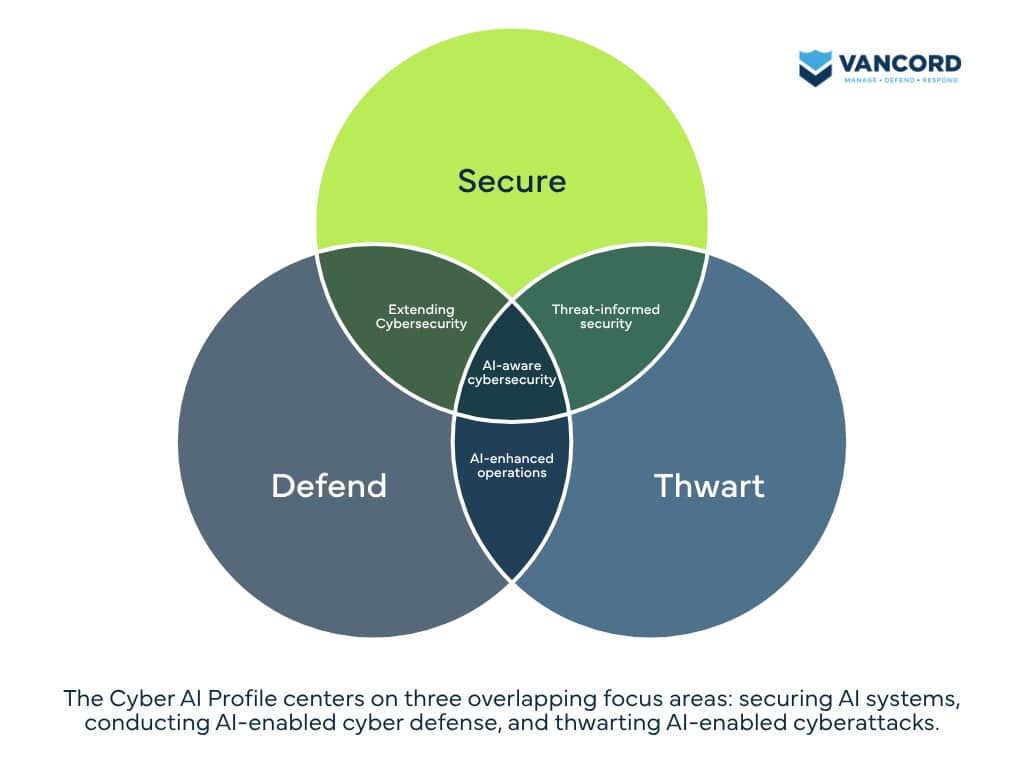
Source: National Institute of Standards and Technology (NIST)
Vancord’s AI Readiness Services can help organizations evaluate how AI fits into their broader security and governance program.
The goal isn’t to slow down useful technology. It’s to make sure security keeps pace with how the business is using it.
Questions Leaders Ask About AI in Threat Detection
How does AI improve threat detection?
AI can analyze large amounts of security data, identify unusual behavior, connect related events, and help prioritize alerts. It gives analysts more context so they can focus on the activity most likely to require investigation.
Can AI replace a SOC analyst?
No. AI can automate parts of detection, correlation, and alert triage, but analysts still provide business context and make important investigation and response decisions.
What is the difference between AI threat detection and traditional security tools?
Traditional tools often rely on known signatures, rules, or indicators. AI-based detection can also analyze behavior and identify patterns that don’t match what is normal for a user, device, or environment.
Is AI-powered security worth it for a mid-market business?
It can be valuable when an organization has more security data and alerts than its internal team can consistently review. The value depends on data quality, integration, detection accuracy, analyst oversight, and how well the system is tuned to the organization’s environment.
Are attackers using AI too?
Yes. It shows up mostly in more convincing phishing, faster reconnaissance, and quicker exploitation of new vulnerabilities. IBM’s 2026 research found AI-driven attacks up 56 percent year over year. That’s a reason to improve detection speed rather than a reason to panic.
Turn Better Detection Into Faster Security Decisions
AI can help security teams see patterns sooner, reduce unnecessary alert noise, and investigate threats with better context. The real value comes from combining that technology with experienced people and a security process built around continuous improvement.
Vancord’s 24/7 managed security services provide continuous monitoring, while its SOC combines automated detection with human-led investigation and response.
If you’re not sure whether your current tools are catching behavior or only catching signatures, that gap is worth knowing about before someone else finds it. Request a security assessment and we’ll show you what your environment looks like from a detection standpoint.