


Switching managed security providers is not a small decision. Most IT leaders only start thinking about it after the same problems keep showing up: slow response, unclear reports, too many alerts, weak communication, or a provider that does not understand the business. The right questions can help you decide whether it is time to stay, improve the relationship, or move to a managed security partner that gives your team better visibility, faster response, and more confidence.
Why IT Leaders Think About Switching Managed Security Providers
Most IT leaders do not wake up one morning and decide to switch providers. The thought usually builds over time.
Maybe alerts are coming in without context. Maybe reports are too technical for leadership. Maybe the provider only shows up when something breaks. Maybe the internal IT team still feels buried in tickets, security noise, and follow-up work.
At first, these issues may feel small. Over time, they become signs that the relationship is no longer working.
A managed security provider should help your team feel more in control, not more confused. If the provider is only sending alerts, but not helping your team understand what matters, that is a problem. If they cannot explain risk in plain language, that is also a problem.
This is where Vancord’s role as a Managed Security Services Provider matters. Vancord combines 24/7 monitoring, incident response, threat intelligence, and managed security support with a dedicated team model built for all sizes organizations across New England. Vancord also states that clients are supported by a dedicated team, not a shared support pool.
Question 1: Are We Getting Real 24×7 Security Support?
Many providers say they offer 24×7 security monitoring. IT leaders should ask what that actually means.
Does the provider have real analysts watching activity? Do they investigate alerts before sending them to your team? Can they respond after hours, on weekends, or during holidays? Or do they simply forward alerts and expect your team to handle the rest?
This question matters because cyberattacks do not follow business hours.
In one Vancord manufacturer cybersecurity case study, unusual VPN activity appeared during a weekend. Vancord’s Security Operations Center detected the activity, investigated it, contained the issue, and helped strengthen identity and access controls. The result was no data loss and no downtime.
For organizations comparing providers, this is one of the most important questions to ask: “When something suspicious happens at 2 a.m., what do you actually do?”
Vancord’s 24×7 Managed Security Services are designed around continuous monitoring, immediate threat response, expert remediation, and support from a U.S.-based Security Operations Center.
Question 2: Will This Provider Reduce Work or Add More Work?
A managed security provider should make life easier for your internal IT team.
If your team still has to review every alert, chase every update, explain every report, and manage every follow-up task, the provider may not be doing enough. That kind of relationship creates more noise instead of more clarity.
This is often where alert fatigue becomes a major issue. Too many alerts can make real threats harder to see. A strong MSSP should help filter noise, prioritize what matters, and give your team clear next steps.
This also connects to Vancord’s post on how managed security providers reduce alert fatigue. That topic is important for IT leaders who feel buried under tools, tickets, and unclear security messages.
A better question than “How many alerts do you monitor?” is “How do you decide which alerts need action?”
Question 3: Do They Understand Our Business or Just Our Tools?
Security tools matter, but they are not the whole story.
A good managed security provider needs to understand how your organization works. A manufacturer may care most about uptime and production systems. A school may care about student data and learning continuity. A public sector organization may care about public services, compliance, and emergency response. A nonprofit may need strong protection without a large internal security team.
That is why a one-size-fits-all security program often disappoints.
Vancord’s industry pages for manufacturing, education, and public sector show how security needs change by environment.
This is also where Vancord’s human-first approach matters. In one Vancord IT modernization case study, a manufacturer had worked with a large national provider but needed more consistent service, better communication, and a stronger IT foundation. Vancord helped create a more responsive and proactive support model, which is exactly the kind of improvement many IT leaders want when considering a switch.
Question 4: What Will Switching Actually Look Like?
This is the question that often slows the decision down.
Even when the current provider is not working, switching can feel risky. IT leaders worry about monitoring gaps, tool changes, onboarding delays, access issues, and whether the new team will understand the environment quickly enough.
A strong provider should be able to explain the transition in plain language.
Before switching, ask how they handle discovery, access, escalation contacts, reporting setup, existing tools, active alerts, documentation, and communication with internal teams. Ask what happens in the first 30, 60, and 90 days. Ask how they avoid gaps during the handoff.
Vancord’s MSSP approach begins with a review of the current security posture, business needs, and the right mix of managed security services. That matters because switching providers should not feel like starting from zero. The goal is to improve visibility, reduce risk, and make the transition as smooth as possible.
Question 5: Can They Explain Security Risk to Leadership?
IT leaders often sit between technical teams and business leaders. That means a provider’s reporting has to work for both groups.
A report filled with technical terms may be useful for analysts, but it may not help a CEO, CFO, superintendent, plant leader, or board member understand what matters.
Strong reporting should answer simple questions.
What happened? What did the provider do? What risk was reduced? What still needs attention? What should leadership approve next?
Vancord’s Security Operations Center Sample Report is useful for organizations that want to understand what clear SOC reporting can look like.
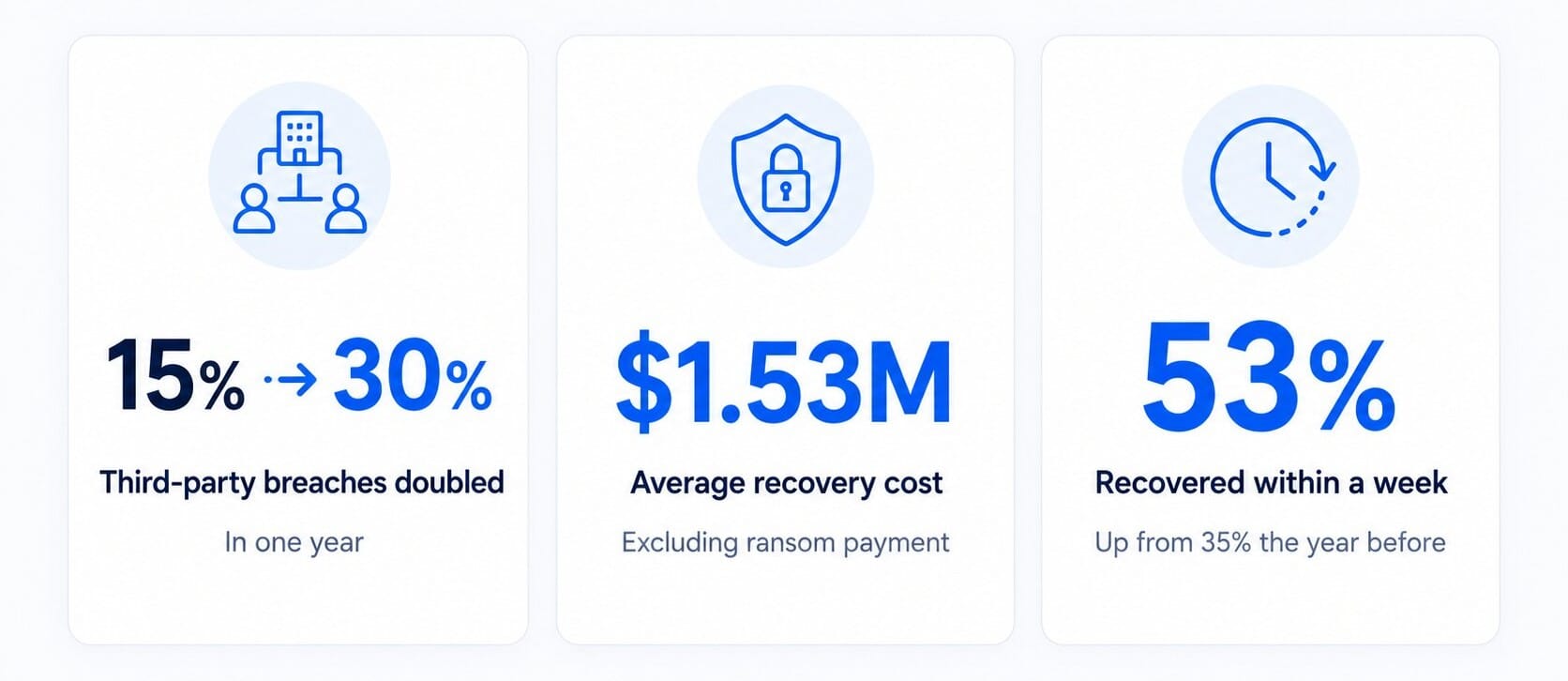
This is also where provider accountability matters. Verizon’s 2025 Data Breach Investigations Report found that breaches involving a third party doubled from 15% to 30% in one year. For IT leaders, that is a reminder that vendors, platforms, and outside providers can directly affect security risk. A managed security provider should help reduce that risk with clear visibility, fast escalation, and reporting that leaders can actually use.
Ransomware recovery is another reason reporting and response quality matter. Sophos’ State of Ransomware 2025 report found that the average recovery cost, not including ransom payment, was $1.53 million. The report also found that 53% of organizations recovered within a week, up from 35% the year before. That shows why faster, clearer response is so valuable when comparing managed security providers.
Question 6: Can They Support Both Security and IT Operations?
Some providers are strong in security but weak in day-to-day IT operations. Others provide IT support but do not have deep security response skills.
Many mid-market organizations need both.
A security alert can involve identity, endpoints, cloud access, network design, patching, user behavior, and help desk workflows. If the provider only sees one part of the environment, it can take longer to understand the full issue.
That is why Vancord’s combined positioning as a Security-Enabled MSP and Managed Security Services Provider is valuable. It gives organizations a partner that can support daily IT needs while also strengthening monitoring, response, compliance, and security strategy.
For many IT leaders, this is the real goal. They do not want another vendor to manage. They want a trusted partner that can help reduce risk and keep operations moving.
Question 7: How Will We Measure Success After Switching?
Switching providers should lead to visible improvement.
That does not always mean flashy dashboards. It may mean faster response, clearer reporting, fewer low-value alerts, stronger endpoint visibility, better escalation, improved compliance readiness, and a calmer internal IT team.
In one Vancord nonprofit IT and security case study, the organization moved from ticket chaos to a more structured support model with better ticket tracking, service levels, escalation paths, Quarterly Business Reviews, infrastructure improvements, and stronger security.
That kind of progress is what many IT leaders want from a new provider: less confusion, more order, and a clearer path forward.
The question to ask is simple: “Six months from now, what should feel better?”
A good provider should have a clear answer.
FAQ: Switching Managed Security Providers
When should an IT leader consider switching MSSP providers?
An IT leader should consider switching when the current provider is slow to respond, unclear in reporting, weak on communication, too focused on tools, or creating more work for the internal team.
Is switching managed security providers risky?
It can be risky without a clear plan. A strong provider should explain onboarding, access, escalation, reporting, tool review, and how monitoring gaps will be avoided during the transition.
What should I ask a new managed security provider?
Ask how they handle 24×7 monitoring, alert triage, incident response, reporting, onboarding, tool integration, escalation, compliance, and leadership communication.
Should we switch MSSP providers if we already have internal IT?
Internal IT and an MSSP should work together. The right provider supports the internal team with monitoring, threat detection, response, reporting, and security guidance.
What makes Vancord different from a basic provider?
Vancord combines managed security, 24×7 SOC monitoring, managed IT, incident response, compliance support, and strategic guidance. That gives clients both technical support and security leadership under one trusted relationship.
Choose a Managed Security Provider That Makes Work Clearer
Switching managed security providers is not only about replacing a vendor. It is about finding a partner that helps your team see risk clearly, respond faster, reduce noise, and make better security decisions.
If your current provider is not giving you that level of support, Vancord can help you take a closer look.
Start with a conversation with Vancord’s cybersecurity team to review your current managed security setup and see what stronger support could look like.