


Picture two companies hit by the same hacker on the same night. One spends three days just figuring out what happened. The other knows within the hour who is likely behind the attack, what that group usually does next, and exactly which systems to lock down first. Same threat, very different outcomes. The difference is threat intelligence. In this post, we’ll look at how threat intelligence improves both threat detection and incident response, why it cuts down on false alarms, and how it turns a scary alert into a clear plan of action.
What Threat Intelligence Adds to Detection and Response
Threat intelligence is information about real attackers. It covers the tools they use, the tricks they rely on, and the types of businesses they go after. Think of it as a scouting report on the other team.
Detection and response are the two halves of stopping an attack. Detection is spotting trouble. Response is what you do once you find it. Cyber threat intelligence makes both halves better, and that second half is the one most businesses overlook.
We’ve already covered the early warning side in our post on how threat intelligence helps detect attacks earlier. This time we’re going further into the full loop, from the first alert all the way to the fix. Vancord’s threat intelligence services are built around that loop, gathering data from many sources and turning it into plain guidance your team can act on.
Sharper Threat Detection With Fewer False Alarms
Here’s a problem most security teams know too well. Their tools flag everything. Vectra AI’s State of Threat Detection research found that security teams receive an average of 4,484 alerts every single day, and 67 percent of them never get a proper look. There simply isn’t enough time.
Threat intelligence helps fix the quality problem behind all that noise. Instead of flagging anything unusual, your tools can focus on activity that matches what real attackers actually do. That includes known bad IP addresses and domains, but also behavior patterns. Maybe the groups targeting companies like yours tend to log in at odd hours, then quietly create a new admin account. When your monitoring knows that pattern, the alert that fires is an alert worth reading.
This is a big part of how a security operations center stays sane. Analysts stop drowning in false positives and start spending their time on threats that matter. We’ve written before about how managed security providers reduce alert fatigue, and good intelligence is one of the main ingredients.
Faster Incident Response When Every Minute Counts
Now for the part that doesn’t get enough attention. What happens after the alert?
Speed matters more than ever. Verizon’s 2026 Data Breach Investigations Report found that ransomware showed up in 48 percent of all breaches. Ransomware is a race. The attacker is trying to spread and lock your files before anyone notices, so every minute your team spends confused is a minute the attacker gets for free.
When a serious alert fires, responders need answers to a few basic questions. Is this real? How far has it gone? What will the attacker try next? Threat intelligence answers those questions quickly, because most attack groups reuse the same playbook again and again. If the activity on your network matches a known group, your team can skip the guesswork and jump straight to action.
In practice, intelligence speeds up almost every step of a response:
- Triage gets quicker because analysts can confirm whether an alert matches real attacker behavior.
- Scoping improves because the team knows where that type of attacker usually goes next.
- Containment gets sharper because responders know which accounts to disable, which machines to isolate, and which addresses to block right away.
- Communication gets easier because leaders receive a clear picture instead of vague technical worry.
This is how managed detection and response teams work, and it’s why containment and restoration can start in minutes instead of days. If you’re curious what that looks like moment by moment, our post on how security analysts investigate threat alerts in real time walks through it.
The payoff is real money. IBM’s Cost of a Data Breach Report found that organizations making heavy use of security AI and automation saved an average of 1.9 million dollars per breach and cut their breach timeline by about 80 days. Threat intelligence is a big part of what feeds those systems. Automation without good intelligence is just a faster way to chase the wrong things.
What This Looked Like for One Manufacturer
A U.S. manufacturer protected by Vancord was hit on a Saturday, when attackers assume nobody is watching. Because the 24×7 monitoring team recognized the behavior right away, they didn’t waste hours wondering if the alert was real. They investigated, contained the threat, and stopped the weekend attack before it became a breach. No downtime. No ransom note waiting on Monday morning. That outcome came from knowing what they were looking at the moment it appeared.
The Feedback Loop: How Response Makes Detection Smarter
Here’s something many businesses miss. Every incident, even a small one, produces new intelligence.
How did the attacker get in? What tools did they use? What did their traffic look like? Once your team answers those questions, that knowledge goes right back into your monitoring. The next time someone tries the same trick, detection happens faster and response starts sooner. Detection feeds response, and response feeds detection. The loop keeps tightening.
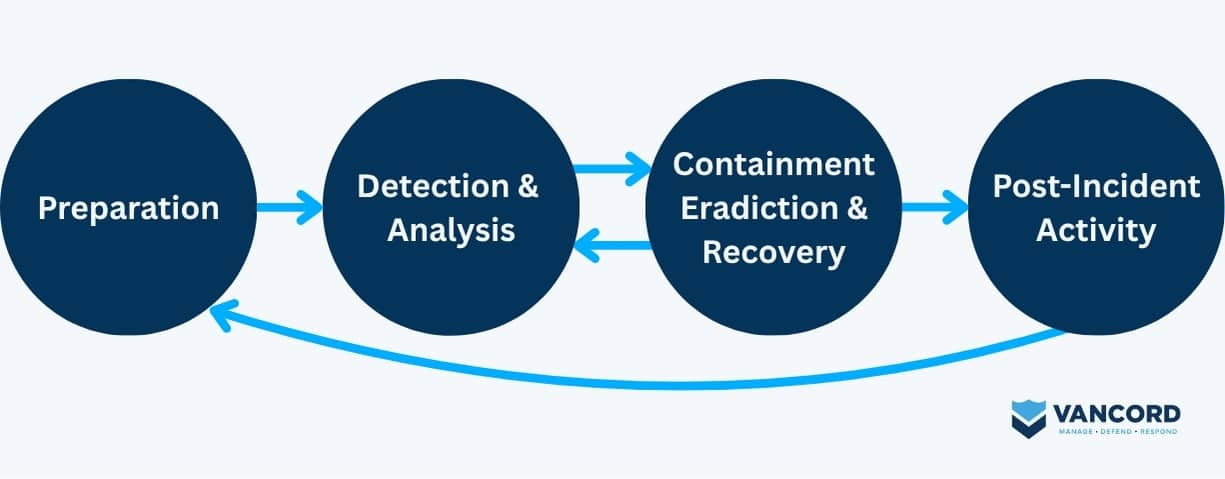
That same knowledge should update your plans, too. Incident response services work best when playbooks reflect the threats your business actually faces, not generic ones copied from a template. And tabletop exercises become far more useful when the practice scenario is built from real attacker behavior. If you’ve ever wondered how fast incident response should be during a cyber attack, the honest answer is this: as fast as your preparation allows.
How Smaller Teams Get Threat Intelligence Without Building It
Most mid-sized businesses can’t hire a team of intelligence analysts, and they shouldn’t have to. The practical route is working with a managed security services provider that already bakes intelligence into its monitoring and response work. You get the benefit without building the program yourself.
Some of that intelligence is even about you specifically. Dark web monitoring, for example, watches for stolen passwords tied to your company. Finding your credentials for sale is an early warning that an attack may be coming, which gives you time to reset accounts before anyone uses them.
Frequently Asked Questions About Threat Intelligence and Response
What is the difference between threat detection and threat intelligence?
Threat detection is the act of spotting suspicious activity on your systems. Threat intelligence is the knowledge about attackers that makes detection accurate and response fast. Detection tells you something is happening. Intelligence tells you what it is, who is likely behind it, and what to do next.
What are the main types of threat intelligence?
There are three common types. Strategic intelligence gives leaders the big picture, like which threats target their industry. Operational intelligence explains how specific attack campaigns work. Tactical intelligence covers technical details, such as bad IP addresses and file signatures, that security tools use to catch threats automatically.
How does threat intelligence reduce false positives?
It gives your tools and analysts context. An alert that matches known attacker behavior gets priority, while activity with an innocent explanation can be filtered out or ranked lower. That means less time wasted on noise and more attention on real threats.
Does threat intelligence replace an incident response plan?
No. You still need a plan that spells out who does what during an attack. Threat intelligence makes that plan smarter and faster, but it can’t replace clear roles, tested steps, and people who know how to carry them out.
The Difference Between a Bad Day and a Disaster
Attacks happen to well-run companies all the time. What separates a bad day from a disaster is how quickly the threat gets spotted and how confidently the team responds. Threat intelligence improves both sides of that equation. It cuts the noise, speeds up decisions, and turns every incident into a lesson that makes the next one easier to handle.
If you want detection and response guided by real intelligence instead of guesswork, talk with Vancord’s security team about where to start. Or take the first step today and request a security assessment to see exactly where your defenses stand.