


The worst ransomware calls don’t always start with panic. They often start with a quiet question: who is supposed to decide what happens next? Someone has found encrypted files. An administrator wants to shut down part of the network. Leadership wants answers. The IT team is trying to understand what happened. Incident readiness closes that gap before a real attack forces people to make critical decisions under pressure.
The fastest way to improve incident readiness is to prepare five things before an attack happens: clear decision-makers, a tested incident response plan, protected backups, reliable security monitoring, and a response that has been practiced.
That preparation matters because ransomware continues to be a serious business risk. Verizon’s 2026 Data Breach Investigations Report found that ransomware was involved in 48% of breaches. The report also found that exploiting software vulnerabilities had become the leading initial access vector, showing why readiness can’t focus on phishing alone.
The good news is that incident readiness isn’t about predicting the next attack. It’s about making sure your organization knows what to do if one happens.
What Is Incident Readiness in Cybersecurity?
Incident readiness is an organization’s ability to detect, contain, respond to, and recover from a cybersecurity incident with as little business disruption as possible.
An incident response plan is one part of that work. Readiness goes further. It asks whether the people named in the plan understand their responsibilities, whether backups can actually be restored, whether emergency contacts are available outside the affected network, and whether the response has been tested.
Think about it this way: a fire escape plan tells you where to go. A fire drill tells you whether everyone can actually get there.
The same principle applies to ransomware.
A strong incident readiness program should answer practical questions before an incident occurs:
Who can declare a cyber incident? Who can authorize shutting down systems? Which applications are most important to the business? Where are clean backups stored? Who contacts legal counsel and the cyber insurer? How will leadership communicate if email and Microsoft Teams are unavailable?
If those answers aren’t clear today, an attack won’t make them clearer tomorrow.
How to Improve Incident Readiness Before Ransomware Strikes
There are several ways to strengthen ransomware preparedness, but five areas deserve immediate attention: decision-making, backups, communications, detection, and practice.
1. Decide Who Has Authority During a Ransomware Attack
Many response plans describe what the IT team should do. Fewer clearly identify who has the authority to make difficult business decisions. Start there.
Name the person who can declare an incident and identify at least two backups for that role. Decide who can isolate systems, disable accounts, shut down network segments, approve emergency spending, and contact outside experts.
This matters because containment can create business disruption. A manufacturer may have to disconnect production systems. A college may need to restrict access to core services. A public agency may have to take systems offline while essential services continue.
Those decisions shouldn’t be made for the first time while an attacker is moving through the environment.
Vancord’s Incident Readiness services help organizations evaluate these decisions and build practical response processes before an emergency occurs.
One useful exercise is to create a one-page emergency decision sheet. Include names, phone numbers, authority levels, critical systems, and the first actions to take. Keep it somewhere ransomware cannot reach.
2. Test Your Backups Before You Need Them
Almost every organization has backups. The more useful question is whether the organization can restore its most important systems within the time the business can tolerate.
A successful backup job doesn’t prove that.
Choose one critical system and perform a real restore in an isolated environment. Record how long the process takes from start to finish. Include the less obvious work, such as locating credentials, confirming application dependencies, rebuilding configurations, and validating that the restored system actually works.
Then compare the result with your business requirements.
If your organization can tolerate eight hours without an application but the tested recovery takes 40 hours, you’ve found a serious readiness gap. Finding that gap during a scheduled test is exactly what you want.
CISA recommends maintaining backups that are protected from ransomware and testing them regularly. Its #StopRansomware Guide also emphasizes planning for recovery and identifying critical systems before an attack.
Your backups should also be protected from the same accounts and systems attackers could compromise. Vancord’s Identity & Access Management services can help organizations strengthen access controls around sensitive systems and administrative accounts.
A backup isn’t proven until you’ve restored from it.
3. Build a Ransomware Response Plan That Works Offline
Your incident response plan won’t help much if ransomware encrypts the server where the plan is stored.
Keep an offline copy of the response plan and emergency contacts. Make sure the people who need access know where those copies are and can reach them without using the organization’s normal network.
The same applies to communication.
Email may be unavailable. Teams may be unavailable. Internal phone systems may be affected. Decide ahead of time how the response team will communicate if normal business tools cannot be trusted.
Your emergency contact list should include internal leaders, IT and security contacts, legal counsel, your cyber insurance contact, relevant vendors, and your incident response provider.
Also decide who communicates with employees, customers, partners, regulators, and the media.
The goal isn’t to write a script for every possible scenario. It’s to make sure your organization doesn’t spend the first few hours trying to figure out who should be talking to whom.
4. Improve Detection Before Attackers Reach Your Critical Systems
Incident readiness isn’t only about what happens after ransomware is discovered.
It also depends on how quickly your organization can recognize suspicious activity.
The 2026 Verizon DBIR found that vulnerability exploitation accounted for 31% of breaches, making software vulnerabilities the leading initial access vector in the report.
That makes visibility especially important. Security teams need to know when an account behaves differently, an endpoint begins showing suspicious activity, or an attacker attempts to move between systems.
For organizations without the staff to monitor security events around the clock, Vancord’s 24×7 Managed Security Services provide continuous monitoring, alert investigation, and response support. Vancord’s U.S.-based Security Operations Center monitors networks, endpoints, and cloud environments and can help isolate confirmed threats.
This is where preparation and detection work together.
The earlier your team identifies suspicious activity, the more options it may have before an incident becomes a major recovery project.
5. Run a Ransomware Tabletop Exercise
A ransomware tabletop exercise is a guided simulation in which leaders and technical teams work through a fictional ransomware incident without taking production systems offline.
It sounds simple. It can reveal a lot.
Bring together IT, security, operations, finance, legal, communications, and an executive with authority to make business decisions. Give the group a realistic scenario and introduce new information as the exercise progresses.
For example, start with several employees reporting inaccessible files. Then reveal that an administrative account shows unusual activity. Later, introduce a failed backup or a critical application that cannot be reached.
At every stage, ask:
- Who decides?
- What information do they need?
- What happens next?
- Where is the evidence stored?
- Who communicates with employees?
- What business function gets priority?
Don’t try to make the exercise look perfect. The uncomfortable moments are often the most valuable part.
Vancord’s Tabletop Exercises & Incident Response Testing can help organizations test their response process and identify gaps before an actual incident.
Incident Readiness vs. Incident Response
The terms sound similar, but they describe different stages of cybersecurity preparation.
| Incident Readiness | Incident Response |
|---|---|
| Happens before an incident | Happens during and after an incident |
| Tests response plans | Executes the response |
| Tests backup restoration | Contains and investigates the attack |
| Assigns decision-makers | Makes incident decisions |
| Runs tabletop exercises | Coordinates recovery |
| Identifies gaps | Addresses the damage |
The two should work together. A response process becomes stronger when organizations regularly test it before they need it.
What Happens If Ransomware Gets Through?
Preparation doesn’t guarantee that ransomware won’t cause disruption. It gives your organization more options when something does happen.
Vancord’s Containment & Restoration Services focus on isolating affected systems, investigating the breach, restoring systems from secure backups, and helping organizations return to normal operations.
The sequence matters.
Vancord’s CyberSound episode “Ransomware Attack Timeline: A Walkthrough of the Disruption” examines real ransomware scenarios and shows how detection, containment, investigation, and recovery can unfold over days or months. One key lesson is that restoring systems before confirming the attacker has been contained can allow the problem to return.
That is why recovery should not be treated as simply rebuilding computers and restoring files.
The organization needs to understand what happened, contain the threat, confirm that the environment is safe enough to rebuild, and then restore critical services in the right order.
What Should Be on an Incident Readiness Checklist?
A practical incident readiness checklist doesn’t need to be 80 pages long.
At minimum, your organization should be able to confirm that it has:
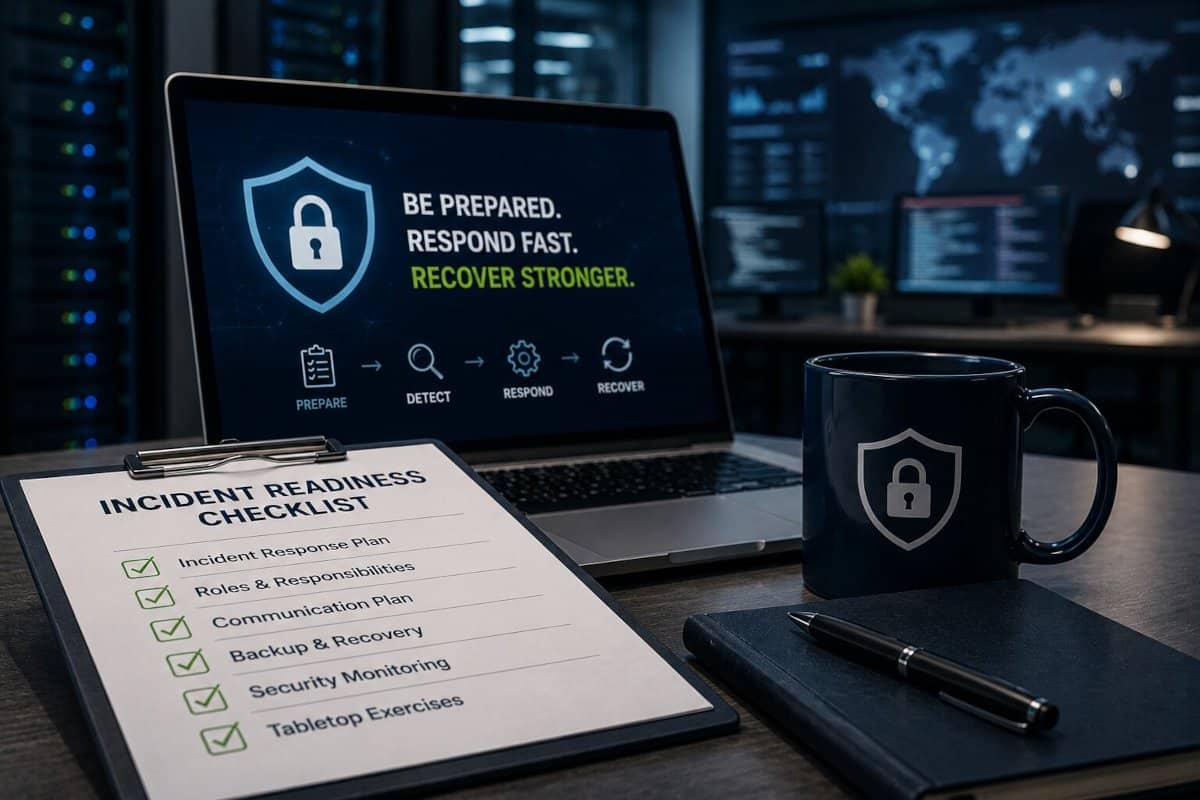
- A named incident leader and backup decision-makers.
- An incident response plan stored somewhere attackers cannot modify.
- Tested backups for critical systems.
- Protected backup administrator accounts.
- An emergency contact list available offline.
- A defined communication process if normal systems are unavailable.
- 24/7 security monitoring or an equivalent coverage plan.
- A ransomware tabletop exercise completed within the past year.
- A documented order for restoring critical systems.
- A process for reviewing and updating the plan after major changes.
The point isn’t to check every box once.
Incident readiness should be reviewed after major technology changes, new business systems, significant staffing changes, and security incidents. A plan that was accurate two years ago may not describe today’s organization.
Which Organizations Need Ransomware Readiness Most?
Every organization can benefit from ransomware preparedness, but the consequences of downtime can be especially serious in certain sectors.
Manufacturers may have production systems that cannot simply be disconnected for days. Vancord’s Manufacturing cybersecurity services address risks across business IT, operational technology, and supply chains.
Public agencies face a different challenge. An attack can affect services residents depend on, which makes ransomware protection for public infrastructure particularly relevant.
Healthcare, financial services, and education organizations also have to consider sensitive information, regulatory requirements, and the operational impact of extended downtime.
The right readiness plan should reflect the organization, not a generic template.
A Real Incident Shows Why Preparation Matters
Vancord’s experience with the Committee for Public Counsel Services offers a useful example. During a serious cybersecurity incident, the organization had hundreds of employees and more than 20 offices across Massachusetts. Vancord supported the response while the organization worked through containment, recovery, and the broader operational impact.
The Committee for Public Counsel Services case study illustrates an important point: incident response isn’t only a technical problem.
People still need to work. Leaders still need information. Business partners may need updates. Legal and regulatory questions may need answers. Recovery has to happen while the organization continues serving its mission.
Preparation can’t remove all of that pressure. It can make the decisions clearer.
Frequently Asked Questions About Ransomware Incident Readiness
What is incident readiness in cybersecurity?
Incident readiness is the preparation an organization completes before a cyber incident so it can detect, contain, respond to, and recover from the event. It includes people, processes, technology, communications, backups, and recovery planning.
How do you prepare for a ransomware attack?
Start by identifying critical systems, assigning incident decision-makers, protecting and testing backups, and creating an offline response plan. A ransomware tabletop exercise can then help your team practice those decisions before a real attack.
What should be included in a ransomware response plan?
A ransomware response plan should identify who leads the response, how affected systems will be contained, how evidence will be preserved, how leadership and stakeholders will communicate, and how critical systems will be restored. It should also include emergency contacts and recovery priorities.
How often should you test a ransomware response plan?
At least once a year is a practical starting point for many organizations, with additional testing after major changes to systems, personnel, or business operations. Backup restoration should also be tested regularly rather than assumed to work.
Start Improving Incident Readiness Before You Need It
You don’t need to predict exactly how the next ransomware incident will unfold. You need to know that your people, technology, and partners are ready to respond when something goes wrong.
That means testing the plan, protecting recovery systems, improving detection, and making decisions before they’re being made under pressure. Strong preparation won’t eliminate every cyber risk, but it can give your organization something valuable when an incident happens: a clear path forward.
If you’re not sure where your current readiness stands, request a security assessment from Vancord and start with a practical conversation about the gaps that matter most to your organization.