



Your scanner produces a list every month, and your team patches what it can before the next list arrives. Then a vendor says that approach is outdated and that you need CTEM instead, and the pitch carries a price tag. Framed properly, CTEM vs vulnerability management is a question about where your limited hours go. This article explains what each one actually does, where they overlap, and how to tell which one your organization needs first.
What’s the difference between CTEM and vulnerability management?
Vulnerability management is the practice of finding and fixing known software flaws on a schedule. Continuous threat exposure management (CTEM) is a broader program that continuously finds any weakness an attacker could use, ranks each one by business impact, and tests whether the fix actually held. CTEM includes vulnerability management rather than replacing it.
That distinction matters because a vulnerability report tells you what your tools found. It does not automatically tell you which finding creates the greatest business risk.
A vulnerability with a high technical severity score may affect an isolated system with strong controls. Another vulnerability with a lower score may affect an internet-facing system that supports an important business service.
Your team needs context to tell the difference. That is where the two approaches begin to separate.
What vulnerability management does well, and where it stops
A vulnerability management program gives your organization a repeatable process for identifying and addressing known security weaknesses.
Vulnerability scanners can identify missing security updates and other known vulnerabilities. Findings can be associated with Common Vulnerabilities and Exposures, or CVEs, and may receive a Common Vulnerability Scoring System, or CVSS, score.
Your team then has to decide what to fix, when to fix it, and how to verify the result.
That work remains essential.Vulnerability management can help your team find weaknesses before attackers exploit them. It also creates useful information for security planning, risk management, audits, and compliance work. The challenge is volume.
A large environment can produce far more findings than an IT team can fix at once. A severity score helps with prioritization, but severity alone does not capture the whole situation.
You also need to know what the affected system does, whether it is exposed, whether exploitation is known, whether another weakness creates a path to it, and what controls already protect it.
CISA provides an important source of additional context through its Known Exploited Vulnerabilities Catalog. CISA describes the catalog as an authoritative source of vulnerabilities known to have been exploited in the wild and recommends using it as an input to vulnerability management prioritization.
That gives your team another useful question:
Is this vulnerability simply severe, or is there evidence that attackers are actually using it?
Vulnerability management answers an important question:
What vulnerabilities do we have, and what needs to be remediated?
CTEM asks a broader set of questions.
What does CTEM add to vulnerability management?
CTEM adds three things: a wider definition of exposure, prioritization based on business impact instead of severity alone, and proof that a fix worked. It runs as a repeating cycle rather than a monthly report.
Vancord’s existing CTEM guidance describes the approach as a repeatable process for understanding where an organization is exposed and deciding what to fix first. It goes beyond traditional vulnerability scans by considering assets, identities, misconfigurations, attack paths, active threats, and business impact.
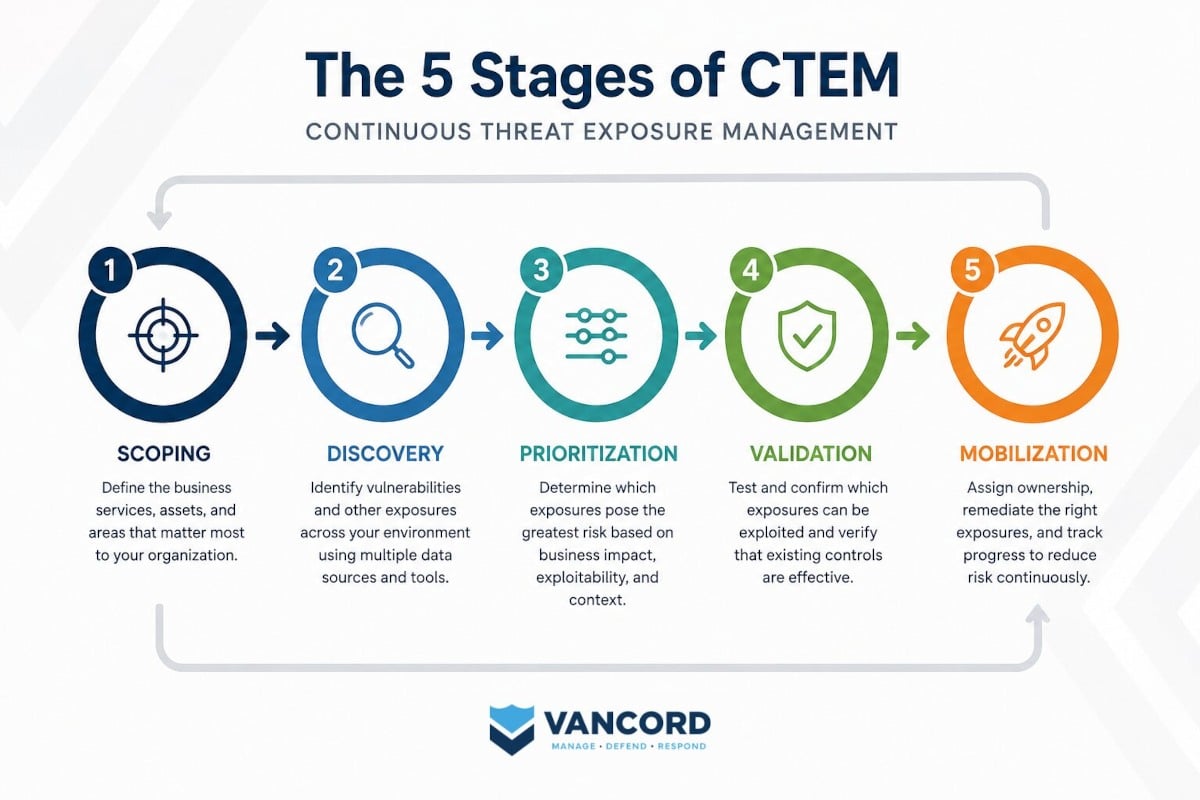
The commonly used CTEM cycle has five stages:
- Scoping: Decide which business services, assets, or areas need attention.
- Discovery: Identify vulnerabilities and other exposures within that scope.
- Prioritization: Determine which exposures create the greatest practical risk.
- Validation: Test whether important exposures can actually be exploited or whether existing controls reduce the risk.
- Mobilization: Assign the work, complete remediation, and continue the cycle.
The important difference is the scope of the problem being examined.
A vulnerability scan may identify a vulnerable application. A broader exposure review can also identify a misconfigured cloud service, an exposed remote access system, an excessive permission, an unknown asset, or another condition that creates an attack path.
That is why vulnerability management is part of CTEM, but CTEM is the broader program.
CTEM vs vulnerability management: How do they compare?
The clearest way to understand CTEM vs vulnerability management is to compare what each approach is designed to accomplish.
| Criterion | Vulnerability management | CTEM |
|---|---|---|
| Primary focus | Known vulnerabilities and weaknesses | Broader security exposure |
| Discovery | Vulnerability scanning and assessment | Multiple exposure sources |
| Prioritization | Often uses severity and asset context | Business impact, exploitability, exposure, and context |
| Validation | Often uses rescanning after remediation | Can include targeted testing and validation |
| Remediation | Patch or mitigate identified findings | Mobilize the right teams around priority exposures |
| Goal | Reduce vulnerability backlog | Reduce meaningful exposure and validate risk reduction |
Neither approach replaces the other. A strong vulnerability management process gives CTEM valuable technical data. CTEM adds a broader decision-making process around that data.
The practical difference is simple:
Vulnerability management tells you what is vulnerable. CTEM helps determine what matters most, why it matters, and whether the resulting action reduced the exposure.
Is CTEM better than vulnerability management?
CTEM is not automatically better than vulnerability management. CTEM is broader, while vulnerability management remains an essential security practice. Organizations should have basic asset visibility, vulnerability scanning, remediation ownership, and verification in place before adding more process or technology.
If your team does not know what assets it owns, a CTEM platform will not solve that problem. You first need reliable visibility. You also need a process for assigning remediation work and confirming that fixes were completed.
CTEM becomes more useful when your team has good basic visibility but cannot keep up with the number of findings. That is the practical trigger.
If your team can consistently remediate its findings based on sensible risk criteria, you may not need a larger exposure management program yet. If your team repeatedly carries the same findings from one scan to the next, the problem may be prioritization, ownership, remediation capacity, or verification.
That is where CTEM thinking can help.
How should you prioritize vulnerabilities and exposures?
Risk-based vulnerability prioritization should consider more than technical severity. Your team should consider whether an asset is exposed, whether exploitation is known, how important the asset is to the business, whether an attacker can reach it, and what controls reduce the practical risk.
Start with the assets that matter most.
For example, a manufacturing company may have production systems that support operations. A healthcare organization may have systems that support patient care or store sensitive information. A municipality may depend on a small number of systems for public services.
Those systems should not automatically receive the same priority as a low-impact workstation.
CISA’s Known Exploited Vulnerabilities Catalog provides another useful signal. If a vulnerability appears in the catalog, your team has evidence that the vulnerability has been exploited in the wild. CISA specifically recommends using the catalog as an input to vulnerability management prioritization.
CVSS can still help describe technical severity. It simply should not be treated as the entire risk decision.
A useful prioritization process combines technical information with business context. The goal is not to create a more complicated score. The goal is to help your team make a better decision about where limited time should go.
Does CTEM replace vulnerability scanning?
No. CTEM does not replace vulnerability scanning. Vulnerability scanning remains an important discovery method within a broader CTEM program, while CTEM adds other forms of exposure discovery, prioritization, validation, and remediation management.
Think of scanning as one source of information.
A scanner may identify a vulnerable application. Other security tools or assessments may identify an exposed service, weak configuration, excessive access, or another condition that a traditional vulnerability scan does not fully explain.
CTEM brings those findings into a common process. That does not mean every organization needs a new platform.
You can apply CTEM principles using tools your team already owns. The important part is the process connecting discovery to prioritization, validation, and action.
How does validation change the process?
Validation checks whether a security exposure presents a practical risk and whether remediation actually addressed the problem. Validation can involve targeted security testing, configuration checks, rescanning, attack path review, or other evidence appropriate to the exposure.
This is one of the clearest differences between a basic vulnerability process and a broader CTEM approach.
A ticket marked “closed” does not always prove that risk was reduced.
If a vulnerability was patched, a follow-up scan can help confirm that the vulnerable version is gone.
If the issue involved an exposed service, the team may need to verify that the service is no longer accessible.
If an identity control was changed, the team may need to confirm that the new access policy works as intended.
For higher-risk exposures, penetration testing can provide deeper validation. Vancord’s penetration testing services use manual testing and simulated attacks to identify weaknesses across infrastructure, cloud, and applications.
Not every vulnerability needs a penetration test.
The important part is having evidence that the remediation addressed the underlying problem.
How does CTEM work with the rest of your security program?
CTEM works best as part of an existing security program rather than as a separate activity. Vulnerability management supplies findings, threat intelligence adds information about active threats, security monitoring provides visibility into attacks, and validation helps confirm whether important exposures can be used or have been reduced.
This creates a useful connection between prevention and response.
For example, a high-risk exposure on an important system can provide additional context when security analysts investigate suspicious activity on that system.
Vancord’s Security Operations Center provides 24/7 monitoring, analysis, and response across endpoint, cloud, and network environments.
Vancord also provides continuous vulnerability management as part of its managed security services, including regular scanning, prioritization, and remediation.
That combination matters because exposure management should not exist in isolation from detection and response.
Does CTEM matter for Connecticut and New England organizations?
CTEM can be especially useful for organizations with limited security resources, complex environments, or critical systems that cannot all receive the same remediation priority. That includes many manufacturers, defense suppliers, healthcare organizations, schools, colleges, and municipalities across Connecticut and New England.
A manufacturer may have production technology that cannot be taken offline whenever an IT team wants to apply a patch.
A school district may have a small technology team supporting hundreds or thousands of users.
A defense supplier may need to manage security requirements alongside operational demands and frameworks such as NIST SP 800-171 and CMMC.
In each case, the challenge is similar: resources are limited, but the organization cannot treat every exposure as equally urgent.
A risk-based approach helps security and IT teams make those decisions based on the systems and services that matter most.
What can your team do this week?
You do not need to purchase a CTEM platform to start applying the basic principles.
Start with one important business service and identify the systems that support it.
Review the vulnerabilities affecting those systems. Check whether any appear in CISA’s KEV Catalog. Then look beyond the scan and ask whether the systems have exposed services, unnecessary access, configuration issues, or other conditions that could increase practical exposure.
Finally, select one finding that your team previously marked as fixed and verify it. If the issue is still present, you have found a process problem worth fixing. If the issue is gone, you have evidence that the remediation worked.
That simple exercise gives your team a small CTEM-style cycle without requiring a new platform.
It also exposes an important difference between collecting security findings and managing security exposure.
How can Vancord help with vulnerability and exposure management?
Vancord is a Connecticut-based managed security services provider with offices in Milford and Glastonbury, and we have worked with New England organizations since 2005. We run IT operations and security together, which matters here because prioritization only works if the team choosing what to fix also understands what breaks when a system reboots.
Our engineers have handled real incidents, including one where we stopped a weekend attack on a U.S. manufacturer before it became a breach. That experience shapes how we rank exposures, because we have seen which ones actually get used.
Most clients start with the vulnerability side and grow into the exposure side as their asset inventory improves.
Frequently Asked Questions
Is CTEM replacing vulnerability management?
No. CTEM does not replace vulnerability management. Vulnerability management remains an important part of finding and remediating known vulnerabilities. CTEM adds a broader process around those findings by considering other exposures, business impact, validation, and remediation. Organizations can use existing vulnerability management tools and processes as part of a CTEM program.
Do you need a CTEM tool to implement CTEM?
No. CTEM is an approach and operating model, not a requirement to purchase a specific software product. An organization can begin with existing asset inventory, vulnerability scanning, security testing, identity data, configuration reviews, and other tools. Dedicated platforms may become useful as exposure data grows, but the process should come before the technology.
How is CTEM different from penetration testing?
Penetration testing is a security testing activity that attempts to identify and demonstrate exploitable weaknesses during a defined engagement. CTEM is a continuous program that includes discovery, prioritization, validation, and mobilization. Penetration testing can support the validation stage of CTEM, but a penetration test by itself is not a CTEM program.
What are the five stages of CTEM?
The five CTEM stages are scoping, discovery, prioritization, validation, and mobilization. Scoping defines what matters, discovery identifies exposures, prioritization determines which exposures deserve attention, validation tests or confirms practical risk, and mobilization moves the required remediation into action. The process then repeats as the organization’s environment changes.
Should a small or mid-sized business use CTEM?
There is no specific company size that determines whether CTEM is appropriate. The more useful question is whether your team can keep up with its exposure backlog and reliably determine which findings matter most. Smaller organizations can apply CTEM principles without buying a dedicated platform, starting with critical assets, risk-based prioritization, and remediation validation.
Can CTEM support NIST SP 800-171 and CMMC efforts?
CTEM can support parts of a security and compliance program by helping an organization identify assets, manage vulnerabilities, prioritize exposures, and produce evidence of remediation and testing. CTEM does not replace NIST SP 800-171, CMMC, or another compliance framework. Organizations still need to address the specific controls, documentation, policies, and assessment requirements that apply to them.
Getting the order right matters more than picking a side
The real question is not CTEM vs vulnerability management. It is whether your team is spending its limited hours on the exposures most likely to be used against you, and whether anyone checks that the fixes held. Vulnerability management gives you the raw material. CTEM gives you the judgment layer on top of it.
Ready to talk through your options?
If you want an outside read on where your exposures actually sit, you can request a security assessment and we will walk through your current program with you.