



Manufacturers often face overlapping cybersecurity requirements from customers, contracts, and industry standards. The challenge is understanding which requirements are mandatory, and how they work together to build a compliant security program. This guide breaks down each framework and describes how manufacturers can consolidate and prioritize the applicable requirements without developing four separate compliance programs.
Compliance Frameworks: What’s the Difference?
Each framework services a different purpose, and while some requirements overlap, they are not interchangeable. Applicable requirements depend on an organization’s contracts, the information being handled, and customer expectations.
1. NIST Special Publication 800-171
This standard defines and provides the mandatory security requirements for protecting Controlled Unclassified Information (CUI) in nonfederal systems. For defense manufacturers, these requirements may become contractor obligations where CUI is involved.
2. Cybersecurity Maturity Model Certification (CMMC)
CMMC provides an assessment framework for verifying that defense contractors have implemented the cybersecurity requirements applicable to their CMMC Level. For example, CMMC Level 2 currently leverages NIST 800-171 Rev. 2 to provide 110 security control requirements.
3. ISO/IEC 27001
This standard defines the requirements necessary for establishing and maintaining an Information Security Management System (ISMS), which comprises the policies and processes used for managing information security. Organizations can implement the standard without pursuing certification, while certification provides independent evidence that the ISMS meets the standard’s requirements.
4. NIST Cybersecurity Framework (CSF) 2.0
A voluntary framework for managing cybersecurity risk across an organization. It has six “Functions:” Govern, Identify, Protect, Detect, Respond, and Recover, which provide a common structure for managing and communicating cybersecurity priorities.
CMMC Requirements in 2026
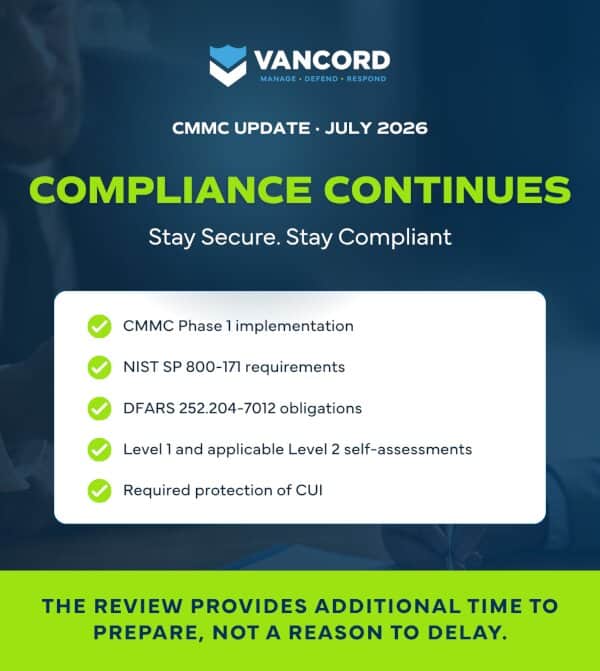
Phase 1 of CMMC implementation began in November 2025, and introduced self-assessment requirements for applicable contracts. On July 13, 2026, the Department of War suspended a planned transition to Phase 2, which would require an independent third-party CMMC assessment and certification as a condition of contract award.
The pause of Phase 2 implementation does not remove existing requirements to protect CUI; Phase 1 currently remains in effect. Contractors subject to DFARS 252.204-7012 must continue to safeguard covered defense information and report any qualifying cyber incidents within 72 hours. CMMC Phase 1 requirements leverage NIST SP 800-171, but manufacturers should also adhere to requirements identified in their specific contracts.
Vancord’s breakdown of CMMC in 2026 provides an in-depth look at current requirements and the self-assessment process for asserting compliance.
Where NIST CSF 2.0 Fits
Unlike CMMC or ISO 27001, NIST CSF 2.0 is not a certification standard. It provides a voluntary, four-tiered approach for managing cybersecurity risk across an organization, helping leadership to identify priorities, assign responsibility, and understand how cybersecurity supports broader business objectives. NIST designed the framework for organizations of all sizes, sectors, and maturity levels. Cybersecurity outcomes are organized across the six “Function” previously mentioned. The “Govern” function is a newer addition, and places more emphasis on cybersecurity governance, enterprise risk, and supply chain risk management. For manufacturers, NIST’s draft “Manufacturing Profile” applies these outcomes to manufacturing systems and operations, including OT environments and supply chain dependencies. CSF 2.0 can also be used to complement the more authoritative requirements, such as NIST 800-171.
Where ISO/IEC 27001 Fits
ISO/IEC 27001:2022 defines requirements for establishing, maintaining, and continuously improving an Information Security Management System (ISMS). Unlike CSF 2.0, organizations can pursue independent certification to demonstrate ISMS compliance with the standard’s requirements. Certification may also be appropriate when a customer, contract, or other business requirement calls for independent assurance. Compliance assessments leverage “Annex A,” which contains 93 reference controls across four themes: Organizational, People, Physical, and Technological. An organization documents each control’s applicability and implementation status in the Statement of Applicability (SoA) within its ISMS.
For manufacturers, ISO 27001 may be relevant when customers, partners, or contracts expect formal evidence of a mature information security management program.
How the Frameworks Compare
While these frameworks overlap in several areas, they differ in purpose, applicability, and assessment and certification requirements.
| NIST 800-171 | CMMC | NIST CSF 2.0 | ISO 27001 | |
|---|---|---|---|---|
| Applicability | For federal contracts that require protection of CUI in nonfederal systems | Per CMMC clauses in applicable Federal contracts | Voluntary for managing org-wide cybersecurity risk | Voluntary unless contractually required |
| Assessment Process | Self-assessment against 110 requirements across 14 security control families. No formal certification. | As described in specific CMMC Level (1/2/3) requirements. | Internal assessment or gap analysis using six “Functions.” Certification is optional unless required by customer contract or procurement. | Internal audit against ISMS requirements w/93 security controls. Accredited third-party audit required for certification. |
| Recertification Cycle | None. Reassessment frequency is organization-defined; continuous monitoring recommended | Level 1: Annual self-assessment, annual affirmation in SPRS. Levels 2 and 3: Assessment every 3 years, annual affirmation. | None | Every 3 years, with surveillance audits. |
Building a Compliance Roadmap
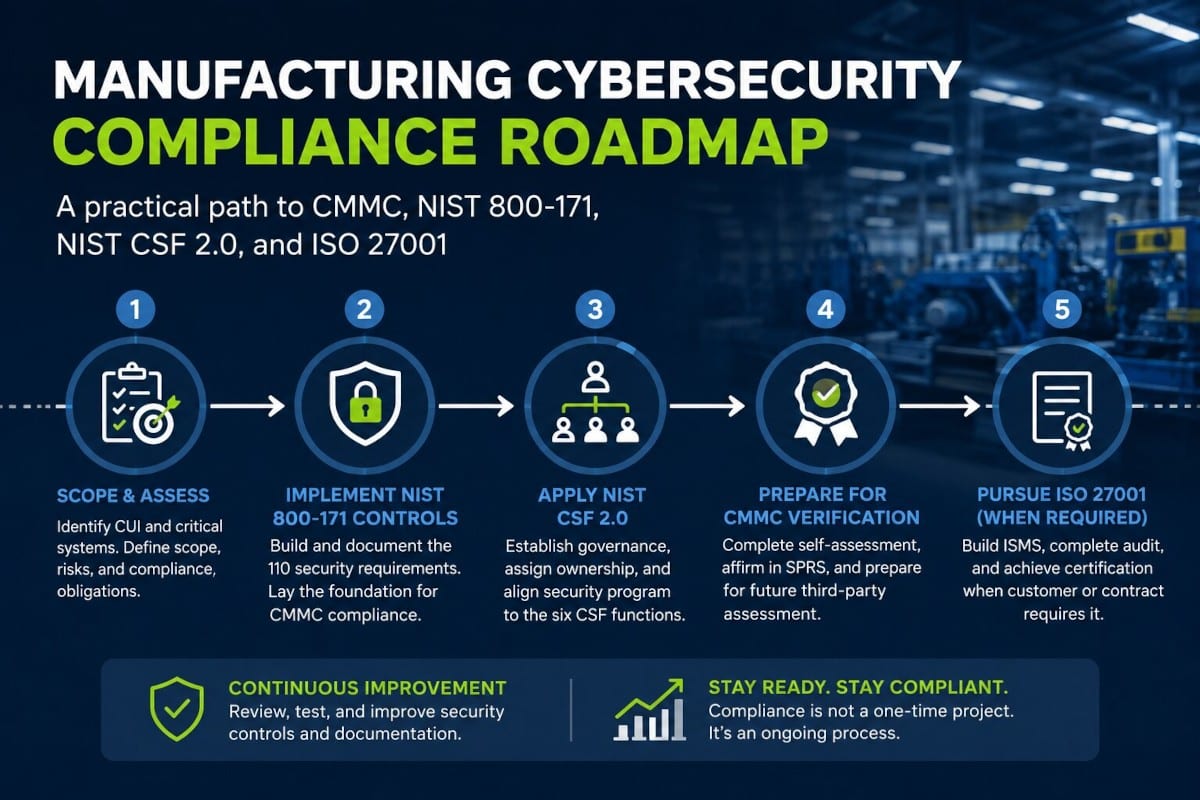
A cybersecurity compliance roadmap is a strategic action plan that helps organizations track the steps needed to meet specific security requirements, standards, and regulations. It typically includes phased milestones, granular task ownership, and set deadlines. Developing a roadmap begins with defining the scope of work. Review contracts, customer requirements, and the types of data involved, then identify the systems, users, and business processes covered by those requirements.
For organizations that handle CUI, initial steps will be guided by NIST SP 800-171 and applicable CMMC requirements. Immediately identifying where CUI is stored, processed, and transmitted helps keep the work focused and avoids scope creep.
NIST CSF 2.0 can support the broader security program by helping leadership identify priorities, assign ownership, and manage cybersecurity risk across the organization. Its Current and Target Profiles can also help document where the organization is today and where it wants to go.
ISO/IEC 27001 may also fit into the roadmap if the organization wants to establish an ISMS or if certification supports a customer, contractual, or business need.
There is no single sequence that works for every manufacturer. The roadmap should reflect the requirements that apply, the organization’s risk, and the resources available to address them. Many organizations begin with a structured compliance audit to recognize and remediate compliance gaps early on.
From Planning to Progress
Once applicable compliance requirements have been identified and prioritized, the focus shifts to execution.
Start by assigning ownership to each action item. Control and process ownership frequently appears in compliance audits, as accountability is an essential aspect of compliance. Next steps include assigning target dates to action items, tracking mitigation and remediation, and updating supporting documentation as needed.
The roadmap should also be reviewed periodically to ensure it accurately reflects the organization’s environment, and risks. Updates to systems, users, network architecture, contracts, or the CUI boundary may affect the roadmap and applicable compliance requirements. Continuous monitoring helps an organization to stay on top of compliance work, preventing a chaotic scramble before the next assessment or customer request.
Ready to build your manufacturing cybersecurity compliance roadmap?
Request a Vancord security assessment to identify the requirements, compliance gaps, and next steps that are applicable to your manufacturing environment.
Frequently Asked Questions
What’s the current status of CMMC?
CMMC Phase 1 remains in effect for applicable contracts. The Department of War suspended the planned Phase 2 rollout in July 2026, so mandatory third-party certification requirements are currently paused while the program is reviewed. Organizations should also follow the requirements listed in their specific contracts.
What’s the difference between NIST 800-171 and CMMC?
NIST SP 800-171 is a framework that defines the security requirements for protecting CUI in nonfederal systems. CMMC is the DoW program used to assess and verify implementation of those requirements at the level specified in an applicable contract.
Do we need NIST CSF 2.0 if we already follow NIST 800-171?
Not necessarily. Each framework serves a different purpose: NIST SP 800-171 focuses on protecting CUI, while CSF 2.0 provides a broader structure for managing cybersecurity risk across an organization. Manufacturers may use both when their needs extend beyond the CUI environment.
When should a small manufacturer consider ISO 27001?
ISO/IEC 27001 is helpful if a manufacturer wants to formalize its cybersecurity program, meet certain customer expectations, or pursue certification for a specific business need. It can be especially beneficial to manufacturers that use connected machinery, industrial IoT, and/or automated systems that make proprietary designs and operational data targets for ransomware.
Is ISO/IEC 27001 certification required?
Not by the standard itself. Organizations can implement ISO/IEC 27001 without pursuing certification. Certification may be useful, or contractually required, when customers or other stakeholders want independent evidence that the organization’s ISMS meets the standard.
How Vancord Supports Manufacturing Compliance
Vancord has helped many manufacturers in understanding applicable cybersecurity requirements, assessing their current environment, and developing a path towards compliance. Our dedicated vISO team supports CMMC, NIST SP 800-171, NIST CSF 2.0, ISO/IEC 27001 and other compliance initiatives while accounting for the operational realities of manufacturing environments. From readiness assessment and remediation planning to policy development, security architecture, and ongoing advisory support, Vancord is here to guide you through the complexities of cybersecurity regulation when you need it.