



Manufacturers spend millions protecting their own networks, yet many cyberattacks begin somewhere else. A supplier with weak security, a compromised software update, or a trusted contractor with remote access can give attackers everything they need to disrupt production. As manufacturing becomes more connected, supply chain cybersecurity is no longer just an IT issue. It is a business issue that affects operations, customer trust, compliance, and revenue. Understanding where these risks exist is the first step toward preventing them.
Why Supply Chain Cybersecurity Matters More Than Ever
Raw material suppliers, logistics providers, engineering firms, machine maintenance companies, cloud software vendors, and managed service providers all help keep production moving. These relationships improve efficiency, but they also expand the number of ways attackers can reach your business.
Today, cybercriminals rarely begin by attacking the largest target in the room. Instead, they look for the easiest path. A smaller supplier with outdated security, stolen credentials, or excessive network access often provides a much simpler way into a manufacturer’s environment.
That strategy is becoming increasingly common.
According to IBM’s X-Force Threat Intelligence Index 2026, manufacturing remained the most targeted industry for the fifth consecutive year, accounting for more than one-quarter of the incidents IBM investigated. The report also found that supply chain and third-party compromises continue to grow as attackers shift toward trusted business relationships instead of direct attacks.
For manufacturers, this changes the conversation. Cybersecurity is no longer limited to protecting your own systems. It also means understanding the security of the organizations connected to them.
What Is a Supply Chain Cyber Attack?
A supply chain cyber attack happens when criminals break into your business through a company you trust. Instead of attacking you directly, they compromise a vendor, supplier, or software provider that already has a connection to you. Then they use that trusted connection to reach your systems, your money, or your data.
Think of it like this. Your building might have strong locks and cameras. But if a delivery driver with a stolen badge walks in the back entrance, none of that matters. That is exactly what supply chain cybersecurity is designed to prevent.
Every connection creates another opportunity for attackers if it is not properly secured.
That does not mean manufacturers should avoid working with outside partners. Modern manufacturing depends on collaboration. It simply means every trusted relationship should also be viewed as part of your cybersecurity strategy.
Why Manufacturers Are Prime Targets
Cybercriminals choose targets for one simple reason. They want the highest possible return with the least amount of effort. Manufacturers offer both.
A production line that stops unexpectedly can cost thousands or even millions of dollars per day depending on the operation. Delayed shipments affect customers, supply agreements, and future revenue. Because downtime is so expensive, attackers know manufacturers often face intense pressure to recover quickly.
Manufacturing environments also present unique technical challenges.
Many organizations operate a mix of modern business systems alongside legacy operational technology that may have been installed years ago. Some equipment cannot be updated easily because downtime interrupts production. Remote access is common for equipment vendors and maintenance providers. Multiple suppliers exchange information every day, creating a large ecosystem that is difficult to monitor without the right tools.
These realities make manufacturing one of the industries where cybersecurity must extend well beyond the traditional network perimeter.
It is also why Vancord has invested heavily in helping manufacturers secure both their business systems and operational technology through its manufacturing cybersecurity services, managed detection and response, and 24/7 Security Operations Center capabilities.
Supply Chain Attacks Usually Start with Trust
One of the biggest misconceptions about cyberattacks is that hackers always “break in.”In many cases, they simply log in.
A trusted vendor account, a compromised email address, or an old remote access account often provides everything an attacker needs.
Imagine a machine vendor that remotely services one of your production lines several times each year.
The relationship is legitimate. Remote access is expected.
But what happens if the vendor’s credentials are stolen?
From your network’s perspective, the attacker may appear to be an authorized user. That is exactly why third-party attacks are so difficult to detect.
The 2025 Verizon Data Breach Investigations Report found that 30% of breaches involved a third party, nearly twice the percentage reported the previous year. While the industries vary, the message is clear. Organizations are increasingly being compromised through trusted relationships rather than direct attacks.
For manufacturers, these relationships can include:
- Software vendors
- Equipment manufacturers
- Managed service providers
- Engineering consultants
- Logistics partners
- Raw material suppliers
- Cloud platforms
- Remote maintenance contractors
Each connection supports the business. Each connection also deserves appropriate security controls.
What Strong Vendor Risk Management Looks Like
Managing third-party cyber risk is not about eliminating vendors. It is about reducing unnecessary exposure while allowing the business to operate efficiently.
The most successful manufacturers usually focus on a few practical habits rather than trying to solve everything at once.
| Traditional Vendor Management | Cybersecurity-Focused Vendor Management |
|---|---|
| Reviews cost and performance | Reviews security practices alongside performance |
| Grants broad access | Limits access to only what is necessary |
| Rarely reviews accounts | Regularly audits third-party access |
| Focuses on contracts | Includes cybersecurity requirements and incident reporting |
| Responds after an incident | Continuously monitors for suspicious activity |
Even small improvements in these areas can significantly reduce supply chain cybersecurity risk over time.
Operational Technology Changes the Risk
Manufacturing cybersecurity is different from many other industries because protecting computers is only part of the challenge.
Production depends on operational technology, often called OT.
These are the systems that control machines, production lines, robotics, programmable logic controllers (PLCs), industrial control systems (ICS), sensors, and other equipment that keeps manufacturing running.

Years ago, OT environments were largely isolated from the internet.
Today, many are connected to corporate networks to improve efficiency, enable remote support, collect production data, and simplify maintenance.
These improvements deliver tremendous business value.
They also create additional pathways for attackers.
If criminals gain access through a compromised supplier or trusted vendor, they may be able to move from traditional IT systems toward operational technology if appropriate segmentation and monitoring are not in place.
That is why modern manufacturing cybersecurity is no longer just about protecting office computers. It is about protecting the systems that keep production moving.
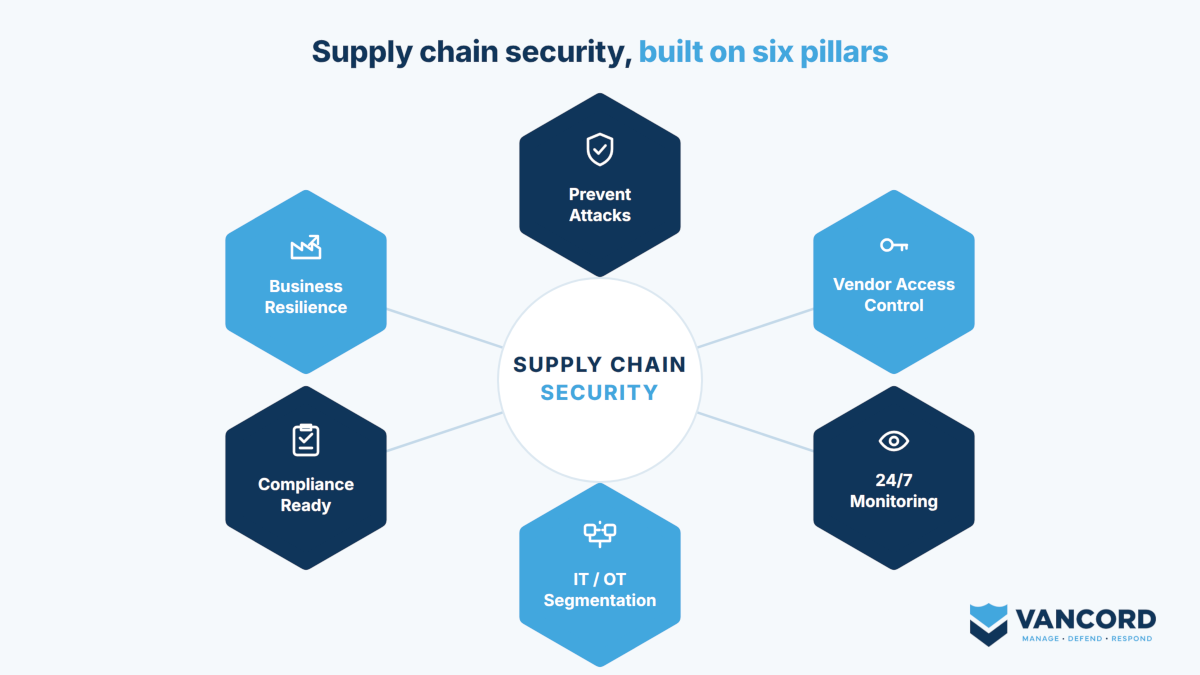
Organizations that separate IT and OT environments, carefully manage vendor access, and continuously monitor for unusual activity are generally far better positioned to prevent a small security incident from becoming a major operational disruption.
Common Supply Chain Cybersecurity Threats in 2026
Most supply chain attacks in 2026 follow a few familiar patterns. Knowing them is half the battle.
Compromised Vendor Credentials
One of the most common attack methods starts with stolen usernames and passwords.
If attackers gain access to a vendor’s account, they may be able to log into customer systems using legitimate credentials. Because the login appears to come from a trusted source, unusual activity can be difficult to spot without continuous monitoring.
This is one reason why multi-factor authentication and strict access controls have become essential for manufacturers and their vendors.
Business Email Compromise
A supplier’s email account is compromised, and the attacker sends invoices, payment requests, or requests to change banking information. Everything looks legitimate because the email comes from the real account.
These attacks are often successful because they rely on trust rather than sophisticated malware.
Compromised Software and Updates
Manufacturers depend on software for production planning, inventory management, shipping, quality control, and machine monitoring.
If a software vendor is compromised, attackers may attempt to distribute malicious updates or exploit vulnerabilities that affect every customer using that platform.
Several high-profile software supply chain attacks over the past few years have shown how one compromised vendor can impact thousands of organizations.
Excessive Vendor Access
Many vendors receive administrator-level access during a project but never lose those permissions after the work is complete.
Months or even years later, those forgotten accounts can become an easy entry point for attackers.
Regularly reviewing third-party access is one of the simplest ways to reduce unnecessary risk.
Supply Chain Cybersecurity Starts with Visibility
Manufacturers cannot protect what they cannot see.
The first step is understanding exactly who has access to your environment.
Many organizations are surprised to discover just how many third parties connect to their systems every month. Equipment manufacturers, HVAC vendors, accounting providers, cloud platforms, maintenance contractors, logistics companies, and software vendors may all have some level of access.
Creating an inventory of those relationships provides a foundation for better decision-making.
Once you understand who has access, the next questions become much easier.
- Does this vendor still need access?
- What systems can they reach?
- Are they using multi-factor authentication?
- Are their permissions limited to only what they need?
- How would we know if their account was compromised?
These conversations often uncover risks that have existed for years without anyone realizing it.
Compliance Is Driving Better Supply Chain Security
Many manufacturers first begin improving supply chain security because a customer asks questions.
Prime contractors, healthcare organizations, financial institutions, and government agencies increasingly expect suppliers to demonstrate that they take cybersecurity seriously.
For manufacturers supporting the Department of Defense, compliance with CMMC, NIST SP 800-171, and DFARS requirements often includes protecting Controlled Unclassified Information (CUI) throughout the supply chain.
Even organizations outside the defense sector are seeing more security questionnaires, vendor assessments, and contractual cybersecurity requirements than ever before.
Preparing early is almost always less expensive than rushing to meet requirements after a contract is at risk.
This is one reason many manufacturers begin with a cybersecurity readiness assessment. It provides a clear understanding of current risks, identifies compliance gaps, and helps prioritize improvements based on business impact.
Real Security Is Continuous, Not Annual
One of the biggest mistakes organizations make is treating cybersecurity like a yearly project.
Attackers do not work once a year. Neither should your security program.
New vendors are added. Employees change roles.Software is updated. Remote access is created. Threats evolve every day.
That is why continuous monitoring has become one of the most effective ways to reduce cyber risk.
In one recent Vancord engagement, a U.S. manufacturer experienced suspicious activity outside normal business hours. Because security monitoring was already in place, analysts quickly detected the activity, investigated the alerts, and helped stop the attack before it disrupted operations. What could have become days of downtime instead became a manageable security event.
Stories like this demonstrate an important lesson.
The sooner suspicious activity is detected, the more options an organization has to contain it.
Supply Chain Cybersecurity Is a Competitive Advantage
Cybersecurity is often viewed as a cost. In reality, it is becoming a business advantage.
Customers want to know their suppliers can protect sensitive information.
Partners want confidence that their operations will not be interrupted by avoidable cyber incidents.
Insurance providers increasingly evaluate cybersecurity before issuing or renewing policies.
Strong cybersecurity also helps organizations respond to audits more confidently, strengthen customer relationships, and compete for contracts that require higher security standards.
Manufacturers that invest in cybersecurity today are not simply reducing risk.
They are building resilience that supports long-term growth.
Frequently Asked Questions
What is supply chain cybersecurity?
Supply chain cybersecurity is the practice of protecting your business from cyber threats that originate through vendors, suppliers, contractors, software providers, or other trusted third parties connected to your organization.
What is the biggest supply chain cyber risk for manufacturers in 2026?
Vendor email compromise leads the pack. Attackers take over a real supplier’s email account and use it to send fake invoices or bank change requests. Because the message comes from a trusted address, it slips past filters and people alike. Compromised third-party software is a close second.
Do small manufacturers really need to worry about this?
Yes, maybe more than anyone. Attackers use small suppliers as stepping stones to reach larger customers. And those customers increasingly require proof of security before signing or renewing contracts. Weak security can cost you business even if you never suffer a breach.
How do I know if my suppliers are secure?
Start by asking. Send key vendors a short security questionnaire, put basic requirements like MFA into your contracts, and limit what each vendor can access. For your own side of the equation, an outside assessment shows you exactly what your customers and auditors will see.
Does supply chain cybersecurity help with CMMC compliance?
Yes. Strong third-party risk management supports CMMC, NIST SP 800-171, DFARS, and many customer cybersecurity requirements because protecting supplier relationships is an important part of securing sensitive information.
What should manufacturers do first?
Begin with a cybersecurity risk assessment. Understanding where your greatest risks exist makes it much easier to prioritize improvements and invest in the controls that will have the biggest impact.
Strengthen Your Supply Chain Before Attackers Find the Weakest Link
Every manufacturer is part of someone’s supply chain. The question is whether you are the strong link or the weak one. Vancord has spent two decades helping manufacturers across the US secure their operations and keep production running.
Whether you are preparing for customer security requirements, working toward CMMC compliance, or simply want a better understanding of your cybersecurity posture, taking a proactive approach today can help prevent costly disruptions tomorrow.
Ready to reduce your supply chain cybersecurity risk? Request a cybersecurity assessment from Vancord to identify hidden vulnerabilities, evaluate vendor access, and build a practical roadmap for improving your security posture.
Looking for ongoing protection? Talk with the Vancord team about 24/7 Security Operations Center (SOC) monitoring, Managed Detection and Response (MDR), cybersecurity strategy, and compliance services designed specifically for U.S. manufacturers.